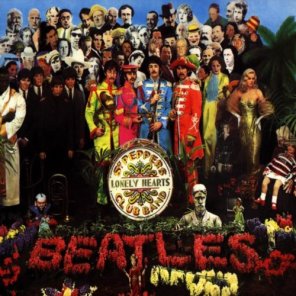
The Beatles, Sgt. Pepper’s Lonely Hearts Club Band, 1967
Label: Parlophone
Producer: George Martin
Universally lauded as the greatest album of all time, what more can really be said about Sgt. Pepper’s Lonely Hearts Club Band? It represents so much from so many different perspectives. It’s certainly the high point in The Beatles’ illustrious recording career, not to mention the most sonically ambitious album ever recorded, regardless of what followed it. Everything else afterward was really following in Pepper’s footsteps after all. As a cultural touchstone, its reach remains unlimited, even over a half century after its initial release. The bright colors and personalities that fill the album cover. The music and performances themselves. The trippy stories they explore. It was the height of the psychedelic era and showcases everything that defined it. And released on the verge of the Summer of Love, it was without question a definitive moment for the entire generation shaped by the turbulent events of the 1960s. A hippie’s anthem in many ways, but it’s also so much more than that. The record explores commercial music in progressively expressive and topical ways that no artist or band had ever dared to explore before.
By this point, The Beatles had officially retired from touring, which, as already evidenced on the preceding masterpiece Revolver, had freed the group to be as creatively innovative as possible in the studio, without concern about the confines of having to perform the music in a live setting. While Revolver had fascinated listeners with magnificent new layers of sonic experimentation, the Fab Four take that vision to new and astonishing heights here. Also a concept album in many ways, with the group taking on the alter-egos of the fictitious Lonely Hearts Club Band, such characterization also provided a new layer of liberation in the performances. Fully committed to those roles, the record begins with the sounds of a “pit orchestra” warming up against the sound of a live audience, before transitioning into George Harrison’s rip-roaring guitar intro, and Paul McCartney and John Lennon’s raucous and now legendary performance of the iconic title track. With the project bleeding from song to song like a true concert, and a veritable musical thrill ride, the opening cut immediately fades into the introduction of band-leader Billy Shears, voiced by Ringo Starr. Here, he delivers the definitive performance of his career on “With A Little Help From My Friends”, one of the group’s true dark horse classics and now a standard friendship anthem. The canned live audience effects beam with the electric sounds of the early days of Beatlemania, and makes for perhaps the greatest one-two punch opening set to an album of all time.
While that thrilling opening segment stuck fairly close to the basic magic of early rock & roll, the third track, “Lucy In the Sky with Diamonds”, busts the gates open for uninhibited sonic innovation. Not to mention, it’s also where the undeniable psychedelic drug influences of the time period also take flight, almost literally. Controversial as those outside factors may have been, there’s no denying the thrilling beauty they helped inspire, and you don’t have to be high on anything but the music to appreciate it. Lennon’s slow, slinky, and sprawling verses of “Diamonds” were the pure definition of a trippy musical acid ride, and the production was equally alluring, thanks to Harrison’s tambura and affected guitar licks. Naturally pairing with this production direction, the Indian influences that Harrison first explored deeply on the group’s two previous LPs returns with “Within You Without You”. Incorporating a gorgeously lush string section along with the hypnotic sounds of the Sitar and dilruba makes for a listening experience that is both ominous and beautiful. Taking the record to yet another level of cosmic wonder is “Being For the Benefit of Mr. Kite!”, Lennon’s brilliantly bizarre portrait of a circus show. His delivery is so completely indulgent in the ridiculous nature of the story that it frees the band to be just as much out there in terms of arrangement and instrumentation. The sounds created make for as equally vibrant imagery as the detailed lyrics themselves, and there’s a twisted sense of danger and evil lurking underneath that is hard to ignore. There’s simply not another band, or another album, that could have delivered such a fantastically unique performance.
For all the diverse, sonic expression to be found throughout the album, it is the band’s ability to seamlessly blend those risks with their basic rock and pop roots that retains an undeniable charm to the overall result. McCartney’s classic pop charisma carries a basic rock track like “Getting Better”, while Lennon’s lyrical solitude sneaks in darker images of abuse and despair underneath. The uniquely crafted “Fixing A Hole” allows groovy layers of psychedelia to fade in and out of an otherwise almost baroque pop setting, while hinting at the mental weight brought on by fame and celebrity. Elsewhere, McCartney’s vaudevillian pop leanings invade the proceedings on chipper nuggets like “When I’m Sixty Four” and “Lovely Rita”, but it somehow works naturally against the wider spectrum of the grander sounds on the album, thanks to the unmitigated lack of boundaries set from the outset of the project.
Ultimately, what truly transcends Pepper’s into a flawless and balanced masterpiece, even more so than the varied sonic textures, would be the band’s evolved mastery at storytelling. Building upon the breadth demonstrated on “Eleanor Rigby”, “She’s Leaving Home” proved to be one of the most beautifully devastating narratives ever recorded. Capturing a story representative of the generational clashes in many homes at the time, the tale follows a conservative couple’s heartbreaking discovery that their rebellious daughter has run away in the dark of night. The brilliance of Lennon and McCartney’s dichotomous partnership glows here, as the latter’s vocals symbolize the freedom the young lady finally finds with her disappearance, while the former’s downtrodden turn brings to life the bitter sadness and confusion experienced by the parents after reading their daughter’s farewell letter. An even more remarkable display of this artistic genius arrives in the form of “A Day In the Life”, a tragic and eye-opening vignette which serves as the album’s encore. Like a great film, both the lyrical and musical progression of the record is enough to make a grown man cry, adding the stunning layers of emotional weight and depth that the album needed. The entire production, recorded over the course of thirty four hours (!), marks the apex of both Lennon and McCartney’s collaborative partnership, as well as the band’s evolution as performers, storytellers and lyricists. This is the moment where art-rock was truly born.
And, in the end, this is truly Sgt. Pepper’s most important accomplishment and contribution to rock music. Not only is the record endlessly entertaining and captivating in countless ways, but it more importantly established how impactful popular music could be as a true piece of art. The album’s relevance goes far beyond its critical or commercial successes, of which there were plenty. It finally, once and for all, announced that rock & roll was not simply a defiant outlet for rebellious youth or champions of the counter-culture. Like classical, jazz, and adult pop music before it, rock music also had something important and meaningful to say and document. It had vision. It had intelligence. It had merit. The road to the acceptance of those things may have already been traveled prior to Sgt. Pepper’s Lonely Hearts Club Band, but this was the moment where such standards finally became accepted and expected as a norm in rock music. Rock and pop albums were now expected to live as a soulful documentation of art, not simply a collection of songs, and that change in perspective can be seen in the countless efforts that attempted to follow in this album’s footsteps in the months and years ahead. The timeline of music history would simply look drastically different without this record. It’s a living and breathing documentation of an entire popular art form changing and evolving. And best of all, on its own merit as a singular album and performance, it also remains as thrillingly joyful, emotional, and spell-binding as it did when it first shocked and entertained listeners over five decades ago.
 The 706
Leave a comment