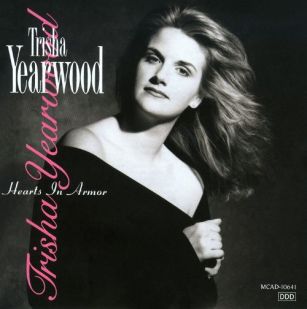
Trisha Yearwood, Hearts in Armor, 1992
Label: MCA
Producer: Garth Fundis
While Trisha Yearwood’s 1991 debut was a hit-making charmer and announced the arrival of a powerful and promising new country voice, her follow-up one year later not only solidified her star status, but also proved to be the kind of masterpiece that many artists wait a career for. Her self-titled bow served as the introduction to Trisha Yearwood, the tremendous singer. Hearts In Armor took it one step further and provided the introduction to Yearwood, the impeccable artist. Over time, she demonstrated that she was both a vocal powerhouse in the tradition of Patsy Cline and Tammy Wynette, but also one of those rare album-oriented country artists in the tradition of Emmylou Harris, Rosanne Cash and Linda Ronstadt, primary influences whose fingerprints are all over this fantastic record. Like Harris in the Hot Band era of the 70s, Yearwood and her crack producer Garth Fundis surround themselves with both stalwart musicians, as well as a fortune of exquisite tunes from a diverse well of songwriters, both items that were refreshingly abundant in early 90s Nashville. The results firmly established Yearwood as one of the artistic leaders in the 90s female movement in country music, and it’s easy to argue that another female of her great stature has yet to emerge since. “She’s In Love With the Boy” may have been the initial buzz-maker, but Hearts In Armor is where her watermark standard for contemporary country music was officially put into place.
Contributing to the bold artistic statements made throughout the record was the fact that it was created in the aftermath of Yearwood’s first divorce. As a result, this collection of songs has layers of both despair and triumph delivered with heartfelt conviction. Fundis’ production capably walked the fine line where gritty and honest emotion seamlessly blends with commercial sparkle, rewarding Yearwood with another healthy run of hit singles, and country radio with some of the very best songs of its final golden era. Fundis never once allows the production to overshadow Yearwood or Yearwood to overshadow the songs themselves. Case in point: the captivating opener and eventual top five hit, “Wrong Side of Memphis”, a haunting, swampy blues-inflected number from the collaborative pens of Matraca Berg and Gary Harrison. A contemporary spin on a classic theme (the down-trodden, darker side of country stardom), it immediately announced growth on the part of Yearwood’s skills as a vocalist, her lonesome country wail perfectly paired with the relentless twin fiddles of the song’s finale. These same brilliant combinations are on faithful display with “Walkaway Joe”, an even bigger radio hit and easily one of country music’s most iconic 90s moments, not to mention a worthy three-part story classic in any era. Pairing for the first time with one of her most reliable harmony partners in Don Henley, their timeless, potent magic brings to life a classic tale of young heartbreak that stuns today as much as it did upon its initial release.
These two songs would be the perennial centerpiece of any standard record. The beauty of this classic LP is that it’s Yearwood’s voice, not any particular song that is the anchor of this album, and so many of hers that followed it. A rarity among powerhouse singers, she is one whose pure pipes and the extent of her range is just the beginning of her arsenal. She matched that voice with a peerless taste for material, as well as the intelligence to use the tremendous nuances in her delivery as often as those glory notes she could hit with relative ease.
Her stylistic range was another wonder in itself, also covering a wide array of moods, sounds and influences. A song selection undoubtedly inspired by her divorce, another Harrison composition entitled “Nearest Distant Shore” beautifully reflects upon the sorrow and sadness of a broken relationship, with this lover left to choose which will be the victim: herself or the marriage itself. Equally powerful is Beth Nielsen-Chapman’s more pop leaning power-ballad, “Down On My Knees”, which she absolutely knocks out of the park. Again, she knows that every song doesn’t need to be belted out. But when the song calls for it like it does here, Yearwood does so unlike anybody else of her genre or generation. Conversely, in a much more country setting, “Woman Walk the Line” finds Yearwood dipping into an overlooked mid-80s gem from the catalog of her aforementioned idol, Harris who also joins her to provide chilling harmonies in an almost symbolic passing of the torch. Yearwood again soars in these vibrant country trappings, her voice dripping in generous amounts of mandolin and steel. Those surroundings likewise suit her well on the more up-tempo fare present here, such as on The O’Kanes’ “Oh, Lonesome You” and the grassy-gospel Keith Whitley entry, “You Don’t Have to Move That Mountain”. From there, she flips the coin entirely once again with the splendidly smooth “For Reasons I’ve Forgotten”. Featuring lush harmonies from the great Raul Malo, it’s an ode to the Nashville Sound era that would make Chet Atkins proud.
For all the wonderful arrangements and production choices to be found throughout, it’s once again her incredible voice that brings it all home with the title track, which is nothing short of a glorious finale. Stripped down to just a piano, viola, and the return of Don Henley’s wonderful harmony support, this Jude Johnstone composition is just as intense and powerful as its surrounding counterparts thanks to all its subtleties. If one were given the unenviable task of picking one standout from the record, this would likely be it.
In reality however, the entire record itself is truly the standout here. Hearts In Armor is one of those rare records that is flawless from beginning to end, as good as any country record released in an era that was full of excellent albums. It’s a stunning masterpiece, yet just a small piece of Trisha Yearwood’s long-standing legacy. She set the bar high with this one, and has consistently cleared it time and time again in the nearly thirty years since its release.
Track Listing
- “Wrong Side of Memphis” (Matraca Berg, Gary Harrison) *Single Release 1992
- “Nearest Distant Shore” (Harrison, Tim Mensy)
- “You Say You Will” (Beth Nielsen-Chapman, Verlon Thompson) *Single Release 1993
- “Walkaway Joe” featuring Don Henley (Vince Melamed, Greg Barnhill) *Single Release 1992
- “Woman Walk the Line” with Emmylou Harris (Emmylou Harris, Paul Kennerly)
- “Oh Lonesome You” (The O’Kanes)
- “Down On My Knees” (Chapman) *Single Release 1993
- “For Reasons I’ve Forgotten” with Raul Malo (Jamie O’Hara)
- “You Don’t Have to Move That Mountain” (Keith Whitley)
- “Hearts in Armor” with Don Henley (Jude Johnstone)
 The 706