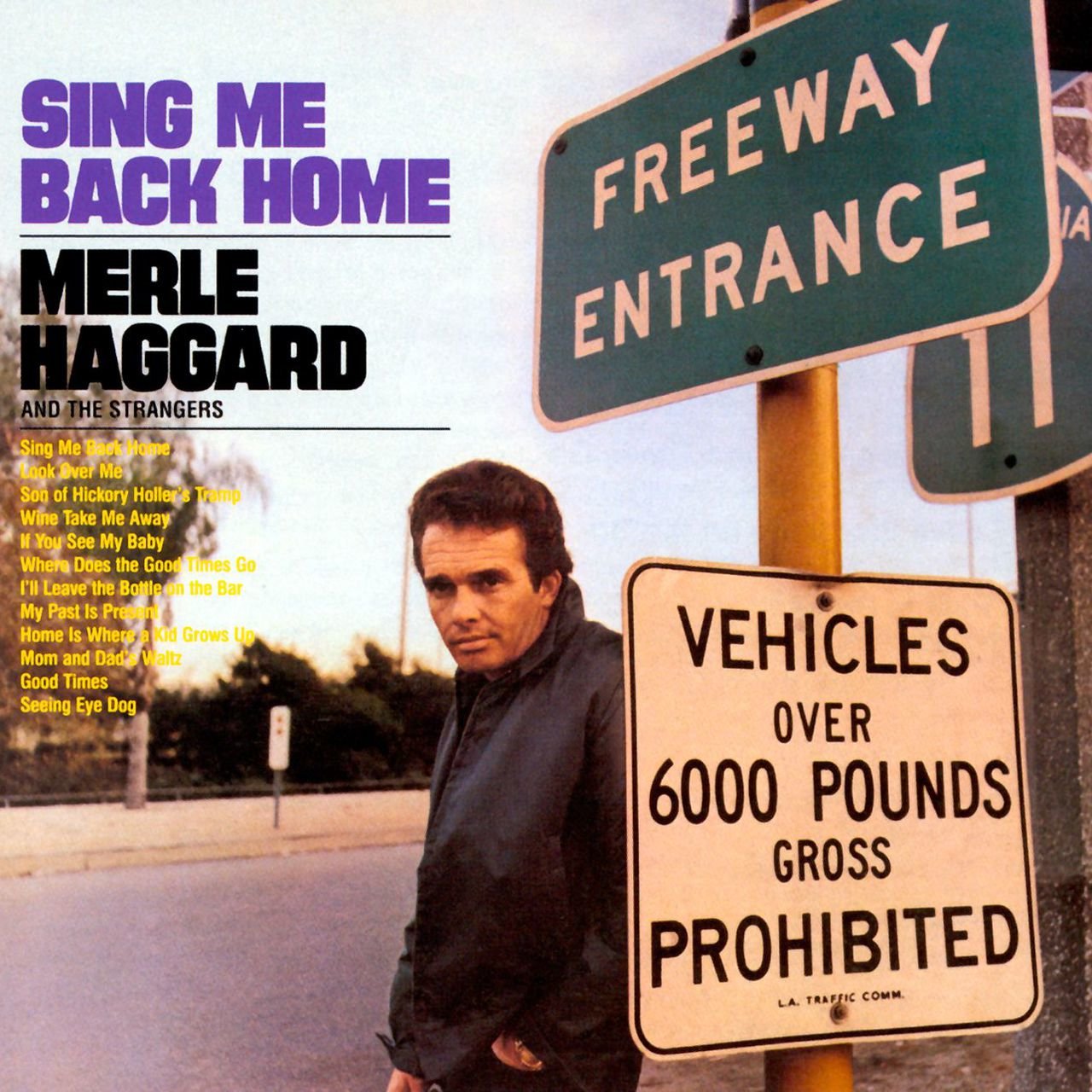
Merle Haggard, Sing Me Back Home, 1968
Label: Capitol
Producer: Ken Nelson
In many ways, 1968’s Sing Me Back Home was the crowning artistic moment that Merle Haggard’s impressive run of albums in the mid-60s had been leading to. The masterful title track, and the album that surrounded it, proved to be the culmination of all the exciting developments and blooming potential that came to increasing fruition over the course of his previous three albums. Pure and simple, this record was his first bona-fide masterpiece, showcasing the fully realized talents of a singing and songwriter master in all his raw, poetic glory. Most rewardingly, it further set the stage for decades worth of additional greatness down the road.
As it relates to the title track, it’s challenging to express the extent of its achievement in words. Harrowing. Beautiful. Devastating. Awe-inspiring. It’s all of those things and more. So stark in its vivid imagery, it’s a testament to Haggard’s exquisite talents not only as a tunesmith, but also his ability to deliver a lyric and bring a story to life. It’s simply one of the most powerful lyrics a pen ever put to paper, and it’s all the more soul-stirring knowing that it came from a real life observation of Haggard’s while he himself was serving time in prison. The captivating guitar intro immediately captures the listener’s attention and the words instantly cut into your soul. Merle’s voice is in its prime and at the core of the story is a universal truth; the fact that music has the ability to take one away to another place in time. The fact that he brought that message to life through a prisoner’s pending execution and simultaneously imbued grace to such an occasion is nothing short of brilliant. This song is not just a country music masterpiece, but a musical masterpiece in general.
The lofty heights of the opening track might lead one to expect this record to be a one-song project, but the remaining material on Sing Me Back Home proves to be sturdy, capable and full of suitable supporting stories for the undeniable anchor of the album. The great Dallas Frazier contributed the juicy Southern Gothic portrait, “Son of Hickory Holler’s Tramp”, a tune loaded with great, little pieces of detailed imagery as it unveils the story of a runaway father, the abandoned mother of fourteen he left behind, and the unsavory profession she resorted to in order to keep them each fed. Sung from the perspective of one of those fourteen, the song never shames the mother, but instead celebrates her willingness to sacrifice for the betterment of her family. Once again, Haggard, with Frazier’s help, demonstrates the magic of country music and the ability of its finest singers to reveal grace, humility, and pride in even life’s darkest and seemingly sinful stories. Co-written with fellow Bakersfield star Tommy Collins, “Wine Take Me Away” carries forward the narrative lineage of “The Bottle Let Me Down”, and provides one of Haggard’s richest vocal turns to date, equal parts tattered and soulful. It’s sung with such commitment and conviction and once again highlights how much Haggard had grown as a vocalist over the course of the 60’s.
That same vocal wonder is evident on “If You See My Baby”, a stylistic detour that slows the tempo down considerably and presents Haggard in a slightly jazzy sonic landscape, further suggesting his considerable versatility as a vocalist. His phrasing is impeccable, making every precise word and turn count, while soft piano turns and rustic mandolin licks shine, but never overshadow his voice as the star. The same countrypolitan-inspired trappings also prove stunning later in the album with the hidden gem, “Good Times”. Both served as signals to Haggard’s further flirtations with jazz, blues and Dixieland influences later in his career.
Of course, it goes without saying at this point that the Hag’s killer supporting ensemble The Strangers is on their proverbial game here, although their roles are slightly downplayed during a good portion of the album. This is due mostly to the nature of many of these stripped-down tunes, however their ability to effectively color the album regardless of the arrangement is another testament to their greatness and to the vision of producer Ken Nelson. With that being said, the band does get plenty of opportunities to amp up their presence when the song calls for it. Those unrivaled Telecaster riffs sound ripped right from Swinging Doors and The Bottle Let Me Down on tracks like “I’ll Leave the Bottle On the Bar”, a pledge for sobriety that sounds deliriously boozy nonetheless, as well as on great covers like Buck Owens’ “Where Does the Good Times Go”, the mournful Wynn Stewart co-write “My Past Is Present”, and the rollicking album closer, “Seeing Eye Dog”, a free-spirited jam that finally gives the band the opportunity to completely let loose before calling it a record.
Two glowing highlights await as Haggard tips his hat to two of his most pivotal influences. The roots-homage “Home Is Where A Kid Grows Up” was a proud co-write opportunity for Haggard and Stewart with the legendary Bob Wills, a musical hero that Haggard would later pay tribute to with an entire album in 1970. The tune itself fittingly speaks to the nostalgic impulse of returning to one’s childhood home in times of strife and struggle. Keeping with that theme of familial roots, Haggard turns in one of the greatest covers of his recording career by revisiting the catalog of another prominent influence with Lefty Frizzell’s heartfelt standard, “Mom & Dad’s Waltz”. Proving again to be just as masterful a lyrical interpreter as a composer, Haggard shifts back to the Frizzell inflections forever ingrained in his own voice, while coloring the performance with a touch of his own vocal signature as well. It’s a wonderful, understated moment on a record rife with heavy, gripping moments, and the band does a splendid job matching the hallmark sounds of 50s country.
A timeless classic that proved to be a standard in both Merle Haggard’s catalog as well as the entire country music canon, Sing Me Back Home was both a culminating moment in his career, and also the impressive launch of continued artistic greatness from a man who would prove to be one of the golden standards in country music as the 60s quickly became the 70s. Remarkably, this was just the beginning of what Haggard would accomplish in 1968 alone, with standards like “Today I Started Loving You Again” and “Mama Tried” waiting in the wings. It ultimately paved the way for a song that before the decade was out would give Haggard the biggest cultural moment of his career. Yet, with all this greatness surrounding it, Sing Me Back Home continues to stand on its own merits as one of Merle Haggard’s crowning achievements as an artist. With a catalog so rich, it’s difficult to peg it as his greatest moment on record, but it’s certainly resides in the very upper echelon. It’s a sterling moment in musical history that admirers of all genres should hear at least once in their lifetimes.
Track Listing
- “Sing Me Back Home” (Merle Haggard) *Single Release 1967
- “Look Over Me” (Haggard)
- “The Son of Hickory Holler’s Tramp” (Dallas Frazier)
- “Wine Take Me Away” (Haggard, Tommy Collins)
- “If You See My Baby” (Eddie Miller, Bob Morris)
- “Where Does the Good Times Go” (Buck Owens)
- “I’ll Leave the Bottle on the Bar” (Haggard)
- “My Past Is Present” (Haggard, Wynn Stewart)
- “Home Is Where A Kid Grows Up” (Haggard, Stewart, Bob Wills)
- “Mom and Dad’s Waltz”(Lefty Frizzell)
- “Good Times” (Haggard)
- “Seeing Eye Dog” (Haggard)
 The 706
Leave a comment