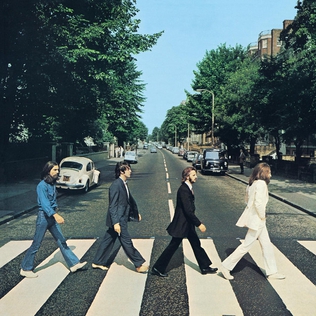
The Beatles- Abbey Road, 1969
Label: Apple
Producer: George Martin
Although it would not prove to be the final studio album release from the Fab Four, Abbey Road would ultimately earn the distinction as the final recorded body of songs that The Beatles ever created in the studio together, effectively concluding an astonishing seven-year span of music that any other band or artist would be happy to have created in an entire lifetime. By the beginning of 1969, the world’s most popular band had been on the brink of complete fracture, having barely survived The White Album sessions without succumbing to a bevy of personal in-fighting and conflicting creative directions. That tension also ultimately resulted in one of their grandest and most stylistically diverse records with The White Album, with each of the four members’ separating musical visions earning ample spotlight. The same sort of diversity could be used to describe Abbey Road, though this album finds producer George Martin making one final attempt to mitigate the implosion of the aborted Get Back sessions to harness all of the turmoil and passion into a focused and cohesive album. To say that Martin succeeded in doing so would be a vast understatement. Although the group lay pretty much in pieces by the time it was completed, Abbey Road emerged as one of, if not the greatest moments in the Beatles’ canon. It marvelously married the group’s raw rock & roll vigor with the sophisticated grandeur and forward-looking experimentation of other pinnacle moments like Revolver and Sgt. Pepper’s, essentially providing a bold blueprint for the rock artists that would carry on in their aftermath as the 1970s dawned.
This record may well contain the greatest one-two punch opening of any album in history, launching with the double A-sided magic of “Come Together” and “Something”. With “Together, John Lennon delivers one of his most snarling and evocatively haunting performances set against a swampy trance of blues-rock that would ultimately rank among the group’s most memorable arrangements. The way the oozing heat of that track still manages to seamlessly segue into George Harrison’s “Something”, one of the truly great love songs of all time, spoke to how effectively suave the band and Martin remained to the end at merging an expansive range of sounds and emotions. Written for his first wife, Patti Boyd, the epic emotional scope of “Something” allowed it to become the landmark standard that essentially confirmed Harrison as one of the greatest songwriters of all time. The second side to this record also offered one of his most beloved jewels with the bittersweet folk-pop of “Here Comes the Sun”. Lennon meanwhile continued to foreshadow the moody spirit and restless depth of his own solo arc, not to mention the advent of blues-soaked heavy metal, with the progressive “I Want You (She’s So Heavy)”, which also emphasized the sound of an emerging new instrument known as the synthesizer.
Enjoying our content? Follow us on Facebook and subscribe using the links below!
The Abbey Road contributions of Paul McCartney and Ringo Starr likewise served as precursors to the musical paths that they too would traverse down in their own respective solo work. The theatrical, chamber music trappings (or “granny rock” as Lennon disparagingly labeled it) of “Maxwell’s Silver Hammer”, as well as the tremendously vintage blue-eyed soul of “Oh! Darling” find McCartney in all of his indisputably passionate glory. In addition to remaining steadfast in his role as the band’s musical and emotional bedrock, Starr also continues to affably commit to spearheading the band’s most charming moments of novelty with “Octopus’s Garden”, a timelessly endearing moment that blows “Yellow Submarine” straight out of its oceanic depths. Listening back now, it’s easy to feel just how underestimated Starr and his contributions were in these moments, a fact that he would joyfully rise above with his own legacy as a solo artist.
Again, as easy as it is to retrospectively call out each of the band-member’s leading moments on the album as signals to their solo futures that soon transpired into the 70s and beyond, each of these moments and the record as a whole remains quintessentially Beatles, as crucially woven into the fabric of their overall artistic story as anything that preceded it. Despite all of the discord behind the scenes, their overall work remained as musically harmonious as it ever had been, with the psychedelic wonder of “Because” literally proving to be one of their final triumphs in this regard. Considering all that they had accomplished in changing and shaping the identity of popular music, it’s obviously easy to get caught up in wide-eyed contemplation over what they could have accomplished and revolutionized had they earned the longevity of contemporaries like The Rolling Stones in the decades ahead. In reality however, there’s an additionally magical and transcendent aura that will forever color their work due to the fact that it’s forever trapped in the sixties. There’s an elevated sense of untouchable stature attached to their work for the fact that it never had to navigate through the forthcoming decades of pop and rock evolution.
With that in mind, it’s difficult to imagine a more fitting conclusion to their formal recorded history than the revered extended medley that occupies the majority of Abbey Road’s second side. Spanning eight song selections and eighteen minutes, it’s one of the most enchanting and celebrated sequences of music in the history of recorded sound, remarkably encompassing the vibrantly restless range of the group’s song-craft and revolutionary musical vision. When McCartney concludes the record by emoting the legendary stanza, “And in the end/The love you take/Is equal to the love you make“, the emotional weight is just as powerful now as it was over half a century ago. It’s a fitting epitaph for the most illustrious and influential musical catalog of all time; the once-scrappy heartthrobs had transformed into a world-changing artistic force, and the musical fandom in turn continues to reward them with an outpouring of adulation and respect to match the stature of great art they gave us.
Enjoying our content? Follow us on Facebook and subscribe using the links below!
Track Listing
- “Come Together” (John Lennon, Paul McCartney) **Single Release 1969
- “Something” (George Harrison) **Single Release 1969
- “Maxwell’s Silver Hammer” (Lennon, McCartney)
- “Oh! Darling” (Lennon, McCartney)
- “Octopus’s Garden” (Ringo Starr)
- “I Want You (She’s So Heavy)” (Lennon, McCartney)
- “Here Comes the Sun” (Harrison)
- “Because” (Lennon, McCartney)
- Medley: “You Never Give Me Your Money” (Lennon, McCartney)
- Medley: “Sun King” (Lennon, McCartney)
- Medley: “Mean Mr. Mustard” (Lennon, McCartney)
- Medley: “Polythene Pam” (Lennon, McCartney)
- Medley: “She Came In Through the Bathroom Window” (Lennon, McCartney)
- Medley: “Golden Slumbers” (Lennon, McCartney)
- Medley: “Carry That Weight” (Lennon, McCartney)
- Medley: “The End” (Lennon, McCartney)
- “Her Majesty (Hidden Track)” (Lennon, McCartney)
Previous: Yellow Submarine

Next: Let It Be
 The 706