
The year 1965 had been pivotal in slowly but steadily expanding The Beatles’ scope in terms of musical style, studio arrangements, and especially subject matter. This trend continues in fascinating fashion as we head into the 1966 period in our Fab Four singles retrospective, which culminated in the landmark release of their seventh album, Revolver, clearly identified as a dividing line in their overall creative arc.
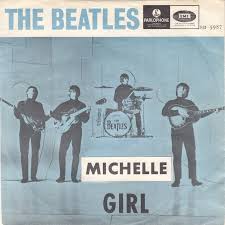
“Michelle” (b/w “Girl”), Capitol, 1966
Songwriters: John Lennon and Paul McCartney
Producer: George Martin
European Only Single
Alright, I’m officially prepared for all of the vitriol and backlash likely to come as a result of this statement: “Michelle” is easily one of, if not my very least favorite Beatles songs. There, I said it. Consequently, all of the accolades that were bestowed upon this track (its mass international airplay regardless of its release status, its win as the Song of the Year at the 1967 Grammy Awards, its bevy of cover versions, and its general regard as a major artistic foot forward) also cause me to regard it as the most overrated song in their catalog. I’ve just always found so much about it rather mundane, especially by Beatles standards: the lyrics, the performance, the melody. One of these areas being lackluster won’t sink a record if the other two are strong, but none of it has ever ultimately connected with me, and I’ve put in the effort. Its one saving grace is the abstract, French-inspired arrangement, which most certainly signaled a maturation and diversification within the group’s stylistic vision.
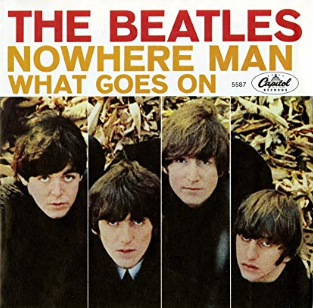
“Nowhere Man” (b/w “What Goes On”), Capitol, 1966
Songwriters: John Lennon and Paul McCartney
Producer: George Martin
#3 (US), N/A (UK)
Now we’re talking. While I generally feel that “Michelle” goes absolutely nowhere, “Nowhere Man” on the other hand has got plenty going for itself. For me, this is a major turning-point in the band’s evolving POV, expanding beyond romance and heartbreak toward other complicated emotions within the human experience. It’s the full culmination of John Lennon’s growing sardonic despair as his fame took hold, depicting a character overcome with general numbness and a lack of inspiration or direction. It’s a sentiment that certainly connected with both youth and adults alike as the turbulent cultural revolution of the 1960s progressed, and its message remains universal decades later. The Beatles were not only capable of crafting iconic love songs and youthful anthems. Here, they also provide a humanistic, downbeat portrait to perfectly soundtrack life’s many crossroads, be it one’s coming-of-age, a midlife crisis, or countless other reckonings. Sonically, it’s also the pinnacle of the group’s folk-rock phase.
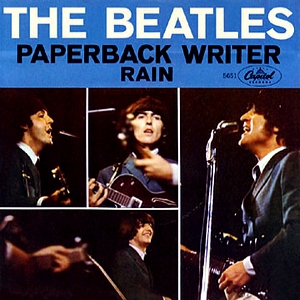
“Paperback Writer” (b/w “Rain”), Capitol, 1966
Songwriters: John Lennon and Paul McCartney
Producer: George Martin
#1 (US), #1 (UK), #1 (Canada)
More thematic evolution is offered in this rollicking smash, which charmingly chronicles a young man’s aspirations of getting published and launching his literary career. It’s an infectious amalgamation of the group’s straight-forward rock sound up to that point, with the increasingly trippy harmonies, wordplay, and fuzzier song structures that would come to define their most experimental and artistic work. It’s also just a fun, offbeat rock jam that never overstays its welcome.
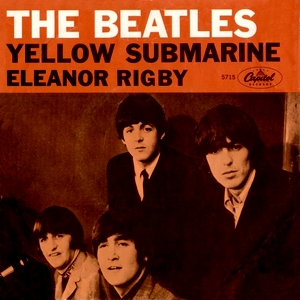
“Yellow Submarine”/”Eleanor Rigby”, Capitol, 1966
Songwriters: John Lennon and Paul McCartney
Producer: George Martin
#2 (US), #1 (UK), #1 (Canada)
Has there ever been a more disparate pair of songs packaged together in popular music history? “Yellow Submarine” was of course born as an attempt to compose a children’s novelty, and it has since grown in stature as a psychedelia cornerstone, and one of Ringo Starr’s most beloved vocal performances in both the group’s and his own singular catalog. It’s not as easy of a song to make a critical target as one might think, for the mere fact that it whole-heartedly owns its ridiculous identity with pride and self-awareness. It never postures to be anything more serious than it is, and it results in one of the most amusing and authentic novelties in the rock canon. “Eleanor Rigby” on the other hand is serious rock art of the highest esteem. Paul McCartney delivers his narrative breakthrough in terms of musical cinema, surveying the scene of a church and the various life-stages observed by the lonely pastor who resides there. Macca’s soulful vocal rendering coupled with producer George Martin’s boldly elegant string arrangement brings the tale to sad but vibrant life. In the process, they deliver one of popular music’s definitive pieces of storytelling, and once again redefined the boundaries of what could be possible in a hit song. Pure and simple, “Rigby” is one of the Beatles’ definitive masterpieces.
Previous:
Next:
Singles, 1967
Enjoying our content? Follow us on Facebook and subscribe by using the links below!
 The 706