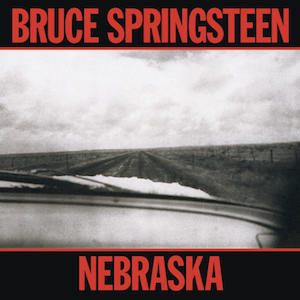
Bruce Springsteen, Nebraska, 1982
Label: Columbia
Producer: Bruce Springsteen
With his commercial momentum on an upward trajectory after the heartland rock triumphs of The River, it seemed like a logical step for Bruce Springsteen to continue in that vein for its 1982 follow-up. That was the original intention with the collection of songs that make up Nebraska, however the stark folk nature of the stories ultimately led the Boss to make a bold move in abandoning the studio recordings and instead releasing the sparse demos as the actual record. It was a risky move; perhaps the most daring artistic decision on the part of a rising mainstream rock star in history. While it may have temporarily stalled his radio success, the ambitious and stirring release became one of his most critically hailed moments and Nebraska ultimately became one of the most heralded and influential rock albums of all time. There’s no glory and triumph to be found here. It’s all pain, doom, and despair. And it’s brilliantly rewarding music.
What unfolds is a stripped down singer-songwriter showcase of the highest and most revealing accord. Seven years had passed since his first record and all those early Bob Dylan premonitions that were thrown his way. This is the moment where Springsteen completely fulfills those stately prophecies. Beginning with the jaw-dropping title track, the set opens with an eerie harmonica solo before segueing into Springsteen’s hushed, almost twangy depiction of a startling murder-streak based on 50s serial killer Charles Starkweather. Each line serves a more shocking and disturbing revelation than the one before it, and Springsteen totally encompasses the character like a skilled actor. It’s twisted, disturbing, and sensationally captivating in all its raw, naked honesty. It sets the stage for an album that pulls absolutely no punches and makes no apologies for its brutal landscape.
Not all the characters throughout the album are as irredeemable as the one unveiled in the title track. As he had so effectively done in all his preceding work, Springsteen digs deep to the core of these people and their stories. Many of them have done horrific things, but their humanity is not completely sacrificed, and Springsteen is able to expose those elements like never before thanks to the absence of The E-Street Band. In many ways, these tales are three-part country songs, with a primitive folk delivery. “Mansion On the Hill”, though not a cover of the Hank Williams standard, aches with all the same lonesome sadness of which that same titled song did, and takes the grim, brooding darkness to a new level. Sung from the perspective of a state sergeant, “Highway Patrolman” portrays an officer of the law looking the other way when it comes to his troubled brother, proclaiming that family betrayal is the worst crime of all. The mysteriously pulsating “State Trooper” follows the tense journey of a down-trodden soul just hoping to make it out of his God-forsaken hometown, without being found-out for whatever misdeeds he may have committed. Set to a spirited rockabilly beat, “Johnny 99” follows the rapid downfall of a laid-off auto-worker whose fate as a convicted murderer came not from that same meanness discussed in the title track, but rather the all-too-real combination of one’s economic woes and their own personal demons.
Surely tapping into the deep, personal issues he had with his own father, “My Father’s House” is a particularly revealing gem. Depicting a nightmare that finds him being chased by the devil and seeking the solace of his father’s home, the narrator awakens determined to repair their damaged relationship only to find that his father is gone and his chance has passed. It’s a telling lesson for any listener, but all the more captivating given the background of Springsteen’s own upbringing. Therein lies another one of his geniuses as an artist. There’s an equal amount of conviction and gravity in every performance, whether he’s being autobiographical or simply a narrator. Each story flows with the same amount of passion and believability, naturally into one another to encompass an overarching and overwhelmingly moving piece of art.
His greatest accomplishment as said narrator certainly appears in “Atlantic City”, the undeniable cornerstone of the album and today a standard that has been covered countless times in concert and on record. With its relentless acoustic strumming, inescapable melody, and a rousing vocal, it’s certainly the most accessible track to be found here, without shedding the stark folk dressing of the entire project. Following the ill-fated journey of a crime-addicted couple, it ties back to many of the themes running throughout Born to Run and other previous Springsteen epics. Like many of those tales, the hunger for escapism and freedom only proves to be a ticking time bomb. The fact that he brings the same fervor and relatable passion to this story with such minimal arrangements as he did on previous full-production pieces speaks more than anything to the overall greatness of both this record and the artist himself.
Nebraska was a sterling showcase for Bruce Springsteen’s brilliance as a songwriter, not an entertainer. His lyrics are the showpiece here. Yet, the unabashed passion, vulnerability, and gravitas on display still allow him to play both roles magnificently. This album is as riveting and rousing as any of the other anthemic blockbusters in his catalog, while also serving as perhaps his greatest artistic achievement. It’s as groundbreaking and influential as any rock album to come before or after.
Track Listing:
- “Nebraska” (Bruce Springsteen)
- “Atlantic City” (Springsteen) *Single Release 1982
- “Mansion on the Hill” (Springsteen)
- “Johnny 99” (Springsteen)
- “Highway Patrolman” (Springsteen)
- “State Trooper” (Springsteen)
- “Used Cars” (Springsteen)
- “Open All Night” (Springsteen) *Single Release 1982
- “My Father’s House” (Springsteen)
- “Reason to Believe” (Springsteen)
Previous: The River
Next: Born In the U.S.A.
 The 706