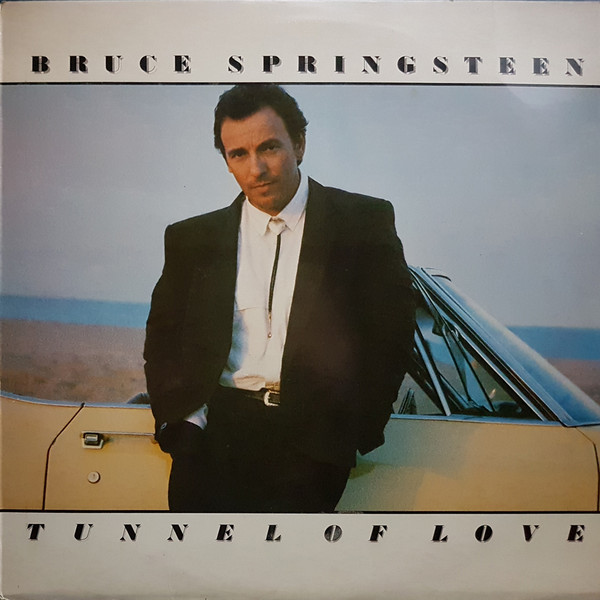
Bruce Springsteen- Tunnel of Love, 1987
Label: Columbia
Producers: Bruce Springsteen, Jon Landau, Chuck Plotkin
Upon its long-awaited release in the Fall of 1987, Bruce Springsteen’s eighth studio album faced a daunting level of pressure and anticipation, the likes of which are reserved for only popular music’s most high-profile box-office moments. It held the unenviable position as the follow-up to 1984’s Born in the USA, the record-setting blockbuster that had dominated pop-culture for the three preceding years, and in the process transformed Springsteen into the biggest rock star in the entire world at this point. Arriving at the absolutely peak of the Boss’ iconic 80s superstardom undoubtedly burdened Tunnel of Love with newfound pressures of which had never before been applied to any previous release in his catalog.
Springsteen obviously knew this, and that the feat of duplicating both USA’s commercial success as well as its lightning-in-a-bottle Heartland Rock cultural explosion was not only staggering, but potentially impossible. Not to mention, those ambitions were also not where his next artistic inclinations lie. Because the fact was that Born in the USA was actually the culmination of something, not the beginning of it. He’d spent the first five albums of his catalog building to the crowning moment he ultimately achieved between 1984 and 1986, and if his newfound, widespread audience wanted more of the Springsteen found on Born in the USA, he already had multiple classics capable of providing them with that. And as Springsteen was composing the material for Tunnel, he found himself dealing with the crumbling of his first marriage to actress Julianne Phillips. This development led him further inward as a songwriter, resulting in his most reflective and personal album to date. Sonically, it also marked a pivot similar to the earlier segue he made when he released Nebraska in the wake of the mainstream success of The River. It was a bold and risky move, especially at the height of his commercial stardom, but it was also one that further established the diversity and longevity of his towering music legacy.
Perhaps the biggest shock to listeners was that Tunnel of Love was not an E-Street Band record; a considerable swerve especially in the wake of the colossal live album that Bruce and the Band released to ravenous praise and acclaim the year prior. Although all of the main E-Street players make some contribution to the record, this album pursued a synthesizer-driven, heavy adult-pop/rock sound. It truthfully proved to better-suit the topical nature of the album, which was in reality Bruce’s most singer-songwriter-rooted album outside of Nebraska at this point. Now, one shouldn’t think that the pop polish robs this album of Springsteen’s classic rock & roll grit or gravitas; one needn’t look any further than the thematic and musically sizzling “Spare Parts” to realize this. Ultimately though, this isn’t an album which collects his signature brand of blue-collar anthems or epic tales of youthful rebellion. Rather, it’s a gripping expose of a relationship’s most vulnerable and ultimately destructive moments. And within those moments, Springsteen unveiled some of the greatest and most-introspective moments of his entire canon.
“Cautious Man” portrays a marriage still filled with love, but one heavily burdened by an intangible void that puts its union on the brink of disaster. “Walk Like A Man” is beautifully narrated from the perspective of a son admiring his father, walking in his parent’s footsteps from childhood on through his wedding day, but now reckoning with independently navigating the personal challenges that married life has presented. “All That Heaven Will Allow” is both gorgeous and heartbreaking, providing both a bittersweet ache and melodic pop-rock of the highest order. “When You’re Alone” is a naked display of pure, unadulterated and unflinching loneliness. “One Step Up” finds a once tender love story that has turned into a “dirty little war”, gracefully permeated by the haunting and now ever-ironic back-up vocals from Springsteen’s next wife, E-Street’s Patti Scialfa.
Meanwhile, it’s “Tougher Than the Rest” where both the album’s thematic and sonic identity really take shape. It’s a gritty and flawed, but undeniably romantic song of love and devotion, but one beautifully tarnished with an underlying sense of pending heartache. Bruce’s rough rock vocal and signature harmonica remains in full-force, while blending against the extra emphasis of the record’s synthesized through-line. The track has become a low-key standard in the decades that have followed, with everyone from Emmylou Harris and Cher to Shawn Colvin and Travis Tritt offering their own interpretations. The title track proves to be the most audacious (and consequently the most-dated) swirl of pop synth on the record, but it works so well to visualize the song’s theme-park-ride metaphor for love’s glorious highs and devastating lows. The juxtaposition of the youthful optimism in the first verse to the doomed disappointment in the final is still raw in its bitter hypnotism nearly four decades later. Elsewhere, “Two Faces” remains a simple but profoundly gripping portrait of a husband’s inner-demons and how they’re destroying his marriage. The other man in the picture is not an outside-lover, but rather the husband’s darker, flawed side. Perhaps what’s most striking about this depiction is the inevitable relatability we all have in terms of allowing our own personality pitfalls to get in our own way, particularly as it relates to our relationships with others.
And then there’s “Brilliant Disguise”; what a God-damned classic and the inarguable centerpiece of Tunnel of Love, not to mention one of the top five moments of Springsteen’s career, in my humble opinion. In many ways, it takes the story of “Two Faces” and frames it in the most realistic and relatable manner, portraying how we can all become strangers in our own relationships, with the third verse revelation where the narrator doesn’t even know himself any longer ranking as the deepest cutting moment. It calls out all of the superficial masks we wear, even for those who are supposed to know us inside and out, not to mention the ones we wear for ourselves. It’s simply one of the most splendid break-up tunes in history. Conversely, “Valentine’s Day” provides its own sterling moment, and an album finale that all these years later still feels very much open to interpretation. It’s tinged with the regret over the lingering loss of a once-great love, depicting a man that seems to be rushing home for the false comforts of a hollow companionship, rather than any remaining love or passion. At times however, it feels like it also has a hidden message of newly discovered romance. Either way, it’s a fittingly complex conclusion to what has become known as Springsteen’s great “divorce” record.
In the end, Tunnel of Love’s stark contrasts to Born in the USA did little to deter the album from becoming a hit in its own right. It reached triple-platinum status in record sales, and also spawned five hit singles, with “Brilliant Disguise” leading the way. More importantly though, its true legacy lies is what a timelessly moving and multi-faceted examination it is of romantic relationships, and how human beings navigate the various stages before, during, and after. Its power lingers strongly all these decades later, making for one of the truly great break-up albums across the pop and rock universe. It proved to be a surprising, rewarding, and ultimately fitting way for Bruce Springsteen to close the chapter on his own glory days of the 1980s.
Track Listing:
- “Ain’t Got You” (Bruce Springsteen)
- “Tougher Than the Rest” (Springsteen) *Single Release- 1988
- “All That Heaven Will Allow” (Springsteen)
- “Spare Parts” (Springsteen) *Single Release- 1988
- “Cautious Man” (Springsteen)
- “Walk Like A Man” (Springsteen)
- “Tunnel of Love” (Springsteen)- *Single Release- 1987
- “Two Faces” (Springsteen)
- “Brilliant Disguise” (Springsteen) *Single Release- 1987
- “One Step Up” (Springsteen) *Single Release 1988
- “When You’re Alone” (Springsteen)
- “Valentine’s Day” (Springsteen)
Previous: Live, 1975-1985
Next: Human Touch
 The 706