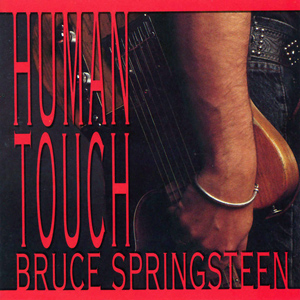
Bruce Springsteen- Human Touch, 1992
Label: Columbia
Producers: Bruce Springsteen, Jon Landau, Chuck Plotkin, Roy Bittan
Bruce Springsteen’s ninth studio release, Human Touch arrived in the Spring of 1992, and found the rock star and his loyal fanbase now nearly five years removed from his last studio full-length, 1987’s divorce-tinged Tunnel of Love. Looking to make up for lost time, the Boss released two albums simultaneously, with this record and its companion, Lucky Town both dropping on the exact same day. The intervening years between records witnessed a sea of changes, both in Springsteen’s life and career, not to mention the modern rock world, of which the early-90s version looked completely different from that of the late-80s. Professionally, Springsteen indefinitely halted The E-Street Band’s run both on the road, and in the studio. Only keyboardist Roy Bittan finds himself a significant holdover from Tunnel of Love to Human Touch, where he shares in both production and composition duties, as well as on the keys in the studio. There had been significant personal changes for Springsteen as well, with his divorce to Julianne Phillips finalizing in 1989, followed by a marriage to E-Street vocalist, Patti Scialfa in 1991 (Scialfa also returns to provide harmony vocals on two tracks here). All of these developments left Springsteen’s rabid fanbase intensely curious as to how their hero would navigate all of this musically, especially now in a post-Nirvana rock scene.
The simple answer to that burning question was that he would mostly stick to the basic signatures that had served him and his music well throughout the E-Street years. There is still some of the late-80s synth that was so central to Tunnel of Love in the air, but for the most part, Springsteen and his newly assembled crop of musicians (Randy Jackson and Toto’s Jeff Porcaro among them) recenter his sound back to a more guitar-centric brand of the kind of polished, roots-rock and pop that was certainly en vogue and dancing on the grave of the 80s excesses of glam and hair-metal. Topically, the singer-songwriter continues to predominantly examine things in the realm of relationships, only now with a notably more uplifting slant in the wake of his marriage to Scialfa.
Now, before we get to the elephant in the room (i.e. the fact that this record is generally regarded as Springsteen’s bottom-rung album, and the inferior of his March 27, 1992 releases), there are various high-points on Human Touch which are important to not gloss over. The record actually begins on a very strong and distinctive note, opening with the hit title track (the final of his top ten hits at Modern Rock radio) which continues the introspective reflections on human connection that were so prominent on Tunnel. This then segues into the alluring rock-soul mystery of “Soul Driver”, which is a truly enchanting record bolstered by the eery production, excellent organ work by an infancy-era E-Street alum in David Sancious, as well as the richly passionate vocals from Bruce and the backing of soul legend, Sam Moore. Among the other gems littered throughout Touch include “Roll of the Dice”, definitely the essential anthem of the album, and one that feels like a true missed opportunity in terms of its undeniable hit-single worthiness. It’s a deep cut Boss moment worth digging for, buoyed by so many of the robust elements that made Springsteen’s brand of Heartland radio rock so fantastic, from the passionate gusto of Bruce’s delivery to the great showcase of Bittan’s classic keys accompaniments. A few other, minor highlights abound with the simmering and brooding intensity of “57 Channels and Nothing On”, a tongue-in-cheek, chest-puffing novelty from the halcyon days of cable television, as well as the closing Western standard, “Pony Boy”, which transports Bruce back to his scrappy, folk roots and makes for a jarring, but nevertheless endearing detour to close the record.
Then there’s the matter of everything that lies in between these album bookends, and likely the most common grievances with Human Touch. The main issue with the album does not lie in the more optimistic nature of the songs, though let’s be honest: much of the very best musical art comes from times of strife and angst, much of which Springsteen had exorcised from his personal life at this point. There’s no doubt that his pen felt a little low on narrative impact, at least comparatively to his prior works. Meanwhile, the updated, streamlined rock-pop sound on the album is pleasantly solid and enjoyable enough to listen to. Unfortunately, it’s often-times not very memorable. The musicianship is astute, but it too is missing much of the unique style and soulful passion that defined the playing of the E-Street Band. At times, this lack of distinction also exposes the issues with Bruce’s diction at times (not a new challenge in his music), which too is usually compensated for with a more unique production and specific narrative POV. These factors combine for what is not a bad album per se, but undoubtedly the most generic in Springsteen’s catalog. The general body of the album, from tracks four through thirteen, feels like one, indiscernible succession of the same mainstream rock song. Essentially, the album is too cohesive at this point, and not concise enough; it would have benefited from editing down to the same ten-track runtime that its sister album received. Now, generic Bruce Springsteen is still worlds better than most any other kind of generic rock or pop, but it understandably leaves plenty to be desired given the greatness he had demonstrated to this point.
Simply put: Bruce Springsteen had set far too high of an artistic bar for himself by 1992. And in those cases, if an artist records frequently and long enough, they’re going to deliver a record that fails to clear that bar. Human Touch is a classic example of this scenario. That said, it’s not the unmitigated disaster that some would dramatically cast it as. In fact, I’d make the argument that Bruce is one of those rare artists in the Classic Rock realm who never ultimately recorded an inarguable stinker. Human Touch is still a pleasant listen all these decades later, and one could even argue that it boasts enough high-points to render it as a vastly underrated release. Regardless, time would soon enough prove that Springsteen still had plenty of great and legendary work left in his tank. If anything, the middling reception to his work during this period likely gave him the inspiration necessary to eventually and once again reinvent himself artistically as the 1990s progressed.
Track Listing:
- “Human Touch” (Bruce Springsteen) *Single Release- 1992
- “Soul Driver” (Springsteen)
- “57 Channels (And Nothin’ On )” (Springsteen) *Single Release- 1992
- “Cross My Heart” (Springsteen, Sonny Boy Williamson)
- “Gloria’s Eyes” (Springsteen)
- “With Every Wish” (Springsteen)
- “Roll of the Dice” (Springsteen, Roy Bittan)
- “Real World” (Springsteen, Bittan)
- “All or Nothin’ At All” (Springsteen)
- “Man’s Job” (Springsteen)
- “I Wish I Were Blind” (Springsteen)
- “The Long Goodbye” (Springsteen)
- “Real Man” (Springsteen)
- “Pony Boy” (Springsteen, Traditional)
Previous: Tunnel of Love
Next: Lucky Town
 The 706