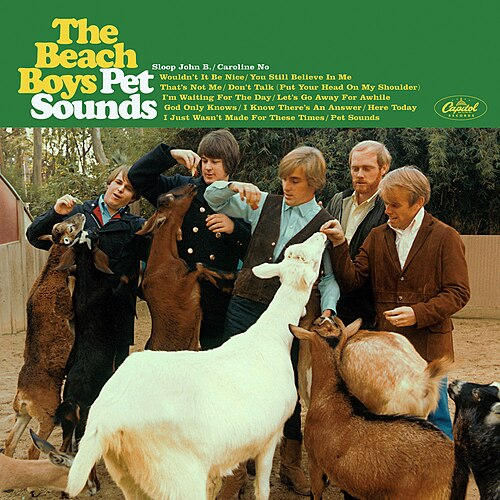
The Beach Boys- Pet Sounds, 1966
Label: Capitol
Producer: Brian Wilson
It’s widely professed, and accurately so, that The Beatles’ 1967 masterpiece, Sgt. Pepper’s Lonely Hearts Club Band, is both the definitive cultural and creative benchmark that officially earned rock music, and popular music in general, acknowledgement as a medium capable of significant artistic achievement. But, Pepper’s did so by building off the momentum of both their own work, and that of other artists who were crafting their own significant creative innovation at the time. The previous year, 1966 was a fascinating, game-changing period in terms of setting this stage. As we’ve already reviewed previously on the blog, this year was witness to the Beatles’ own Revolver, as well as Bob Dylan’s Blonde on Blonde, and The Rolling Stones’ Aftermath. Arguably most significantly, this group also included The Beach Boys’ Pet Sounds. And while today this record appears chief among these influential conversations, its initial public and critical reception was lukewarm, before eventually gaining cult-favorite status, and ultimately acclaim as both the band and leader Brian Wilson’s magnum opus. Today, many would argue that there is no Sgt. Peppers without Pet Sounds, and while that will forever lead to considerable debate, the album’s status as a popular music standard is indisputable.
Wilson had always been the primary vocalist and lyricist for the Beach Boys. However, by the release of Pet Sounds, he had firmly settled in the role of the group’s undeniable creative compass. And while this album was still very much a product and representation of the band as a unit, it is as much a documentary of Wilson’s expansive evolution in terms of his own individual artistic identity and creative vision. His creative restlessness and curiosity had already started to become apparent in the Boys’ musical trajectory on their immediately preceding work, particularly on the prior year’s The Beach Boys Today!, and even further back to their 1964 Christmas album. Capitol Records had worked diligently to maintain the band’s commercial appeal with other releases that were intermingled during this time-period. But it had become increasingly clear that Wilson was determined to grow the Beach Boys past their signature themes of sun, fun, girls, and cars, commercial consequences be damned. Wilson was greatly inspired by producer Phil Spector and the grandiose Wall of Sound arrangements that defined his work, and wanted to incorporate those elements into his own creations with the band.
When the Beatles released the Revolver-precursor, Rubber Soul in 1965, that record’s progressive production and its commercial & critical successes further fueled Wilson’s mission. The two bands had been constantly compared and pitted against one-another, so Revolver not only further motivated Wilson to match the Fab Four’s stylistic diversity, but it also confirmed that the young rock & roll audience was receptive to such growth. For Pet Sounds, Wilson remained at the producer’s helm, and the signature harmonic magic created with bandmates Carl Wilson, Dennis Wilson, Mike Love, Bruce Johnston, and Al Jardine remained front-and-center. However, the band surrendered the majority of instrumental work to the legendary Wrecking Crew. Following in Spector’s sonic footsteps, that instrumental work fully committed to a sophisticated orchestral and border-line avant-garde assortment of “found-sounds” that expanded far beyond the standard rock & roll band make up of guitar, bass, and drums. Meanwhile, Wilson collaborated lyrically on the bulk of the compositions with Tony Asher, who helped him unlock a fountain of complex, introspective reflection and moody, mature adult themes.
Similar to the rapid maturity of the Beatles’ discography, the music found on Pet Sounds was dramatically removed from the carefree youth of their breakthrough, Surfin’ USA just three years prior. Had it not been for those unmistakable voices, this release could have certainly been confused as one from a completely different band. That being said, Wilson astutely chose to start the set with “Wouldn’t It Be Nice”, which would become an undeniable smash, and all-time classic for the group. The musical intro immediately establishes a more baroque tone, but Wilson’s chirpy lead and the Boys’ classic harmonies sound brightly in tune with their other hits. Lyrically, it’s still very much written from the perspective of young love, but there are boldly maturing stakes at play. There’s such a sad despondence and faithless dreaming at the heart of Wilson’s vocal, while the track’s punchy production blissfully subverts it, brilliantly mirroring a blend of classic rock & roll with sophisticated, experimental pop, particularly on the bridge. It’s easily one of the most dazzling opening tracks in music history.
Of course, the overall body of work that follows “Wouldn’t” is decidedly less commercial than its preceding track, as well as that of much of their peers’ output at the time. “You Still Believe In Me” marries rare masculine vulnerability with orchestral flourishes, plucked piano strings, and ringing harpsicord. “Don’t Talk (Put Your Head on My Shoulders)” is a chromatically obtuse track, and a deeply romantic love song, with a string sextet symbolizing the non-verbal emotions shared between two lovers. “I’m Waiting for the Day” is easily one of the most eye-popping arrangements of the album, blending jazz, doo-wop and strings, while contrasting weepy, emotional singing on the verses with jaunty teen-rock anthemia on the chorus. This is really where Spector’s Wall of Sound influences start to fully bloom, then reaching their full realization on the LP’s two instrumental tracks, “Let’s Get Away for a While”, and the majestic title track. The former is a colorful sonic adventure; a collision course between artful nods to vintage influences like Burt Bacharach and edgier, at-times psychedelic touch-tones. “Pet Sounds” meanwhile dramatically earns its titular status as an epic, exotic showcase that incorporates the surf-sound of the band’s early successes with spooky twang, soulful brass, and some wildly rewarding percussion movements. Even the track’s lead single and other big smash, “Sloop John B” has layers of sly and brilliant experimentation hiding underneath it’s chiming, glossy exterior. A sun-kissed interpretation of an early-century folk song, it was definitely not your typical pop-single. Excessive listens throughout the decades simply makes it easy to take for granted just how beautifully unconventional the arrangements and vocals were, making this low-key one of the era’s most vibrantly thrilling hits.
The other classic song on Pet Sounds, and easily its most enduring, is of course, “God Only Knows”. It finds Carl Wilson taking lead and delivering one of the most soulfully gorgeous and somber vocals in history, giving Brian and Asher’s elegant lyrical work a stirring showcase that gracefully birthed its regard as one of the greatest pure love songs of all time. It’s an undeniable standard, but also tapped into a deep well within Wilson’s emotional psyche that in many ways reaches even greater heights on “I Just Wasn’t Made For These Times”, and the LP’s closer, “Caroline, No”. “These Times” is a brutally devastating title, and provided the music and lyrics to match it, finding Wilson grappling with whether there’s a place in the world for both him and the contributions he longs to make to it. With “Caroline”, we’re given a devastating portrait of a man crippled by his regret and sadness over witnessing his ex-lover move on without him. It’s certainly a sobering conclusion to the album, and with its finale’s bizarre sonic backdrop of a passing train and a barking dog, it’s a fitting ending to Pet Sounds. The spirit of these moments are certainly far-removed from the innocent naivete and flirty beach romps of their earlier records, but it’s a fitting topical evolution that mirrors the harsh emotional spectrum between young love and adult heartbreak, as well as the dramatic artistic diversification of the Beach Boys to this point.
The immediate aftermath of Pet Sounds’ release may have rendered a mix of responses, both beloved and bewildered. And that’s a polarizing combination that would define the forthcoming years in the Beach Boys’ career. They continued to tussle between their core, commercial appeal and Wilson’s continually widening creative inspirations, reaching a fever pitch on the following year’s Smiley Smile, and it’s juxtaposition of moments like “Good Vibrations” with “Vegetables” and “She’s Goin’ Bald”. But, it’s unquestionably the brilliance of Pet Sounds that not only critically broadened the band’s long-standing legacy beyond a novelty act, and also introduced popular music to one of it’s greatest architects of all time, in Brian Wilson. Six decades on, this album’s place at the very center of rock music’s artistic awakening is unmistakable. It’s progressive bastion of classic rock, sunshine pop, orchestral pop, psychedelia, avant-garde, and prog-rock sounds certainly provided inspiration and competitive motivation to ground-breaking peers like Dylan, the Stones, and the Beatles. It is indeed natural to assume that Pet Sounds had its fair share of influence on Sgt. Peppers, just as Rubber Soul did on Pet Sounds. And together, they all laid the groundwork for generations of more groundbreaking acts from The Kinks, Pink Floyd, and The Who, to The Moody Blues and Queen, to Tame Impala, Fleet Foxes, and Radiohead. This album is as much an experience as it is record, and one that no serious music-lover can or should go without.
Track Listing:
- “Wouldn’t It Be Nice” (Brian Wilson, Tony Asher, Mike Love) *Single Release 1966
- “You Still Believe In Me” (Wilson, Asher)
- “That’s Not Me” (Wilson, Asher)
- “Don’t Talk (Put Your Head On My Shoulder)” (Wilson, Asher)
- “I’m Waiting for the Day” (Wilson, Asher)
- “Let’s Go Away for Awhile” (Wilson)
- “Sloop John B” (Traditional arranged by Wilson) *Single Release 1966
- “God Only Knows” (Wilson, Asher) *Single Release 1966
- “I Know There’s An Answer” (Wilson, Love, Terry Sachen)
- “Here Today” (Wilson, Asher)
- “I Just Wasn’t Made for These Times” (Wilson, Asher)
- “Pet Sounds” (Wilson)
- “Caroline, No” (Wilson) *Single Release 1966

