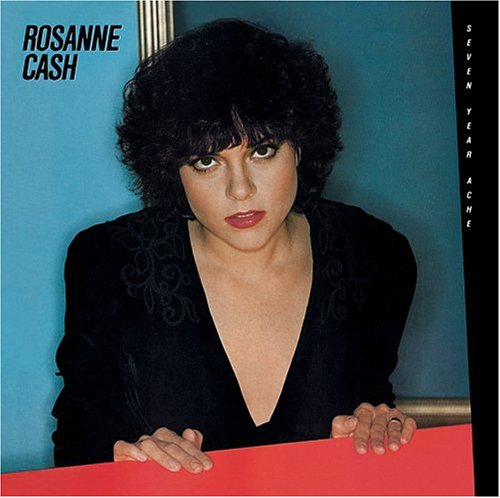
Rosanne Cash, Seven Year Ache, 1981
Label: Columbia
Producer: Rodney Crowell
Forty years after its release, Rosanne Cash’s breakthrough sophomore album not only remains one of the most beloved projects of her stately and prolific career, but also ranks among the essential albums of country music’s polarizing 80s era, and for a multitude of reasons. Among them was the incredible success of the album’s title track, which became Cash’s first of 11 No. 1 country singles as well as a crossover success, while also introducing her as one of the most introspective and ambitious female songwriters to ever hit Nashville . The record also officially established Cash and her then-husband Rodney Crowell as the format’s most potent singer-producer combination of the decade, a turbulent period in country music history marred with unfortunate and cheap attempts at incorporating pop elements into the Nashville music machine. Cash was and is still considered a sort of revolutionary trailblazer for that time period, and it’s not because she was a new traditionalist like Reba McEntire or The Judds. Rather, she had developed a diverse vision for what country music could be, and with Crowell at the producer’s helm, they were unafraid of blending traditional elements with overt touches of rock and pop. What set them apart from their pop-aiming peers was the tasteful and exquisite manner in which they blended those various sounds and influences.
Her breathtaking, crystalline voice is in commanding form, and seamlessly complimented throughout the entire record by Crowell’s smooth rock arrangements. Breaking out from the powerful shadow of her famous father Johnny Cash, she quickly stakes her claim as an important artistic voice with the aforementioned “Seven Year Ache”, widely regarded today as her ultimate moment on record. In reality, it’s just one fantastic moment in a career filled with a slew of similarly great records. That doesn’t demean the importance of the song however. It proclaimed Cash as a progressive and independent female songwriter, something that was still a rarity in country music, with Loretta Lynn, Dolly Parton and stepmother June Carter Cash among the few to come before her. A powerful outcry against a man’s wandering eye, the song became an instant smash, and with its dazzling blend of steel and synth scored high on both the country and pop charts. It was the ultimate crossover record, with a modernized sound and storytelling style that many pop fans didn’t realize country music was capable of prior to this, and it served as the blueprint for the many great records Cash and Crowell would create together in the years ahead.
Additional bold and graceful performances abound as the album continues. Another No. 1 single and the only other Cash composition on the project, “Blue Moon with Heartache” is one of the most melodically beautiful cuts in her entire catalog, indulging in her bluesy penchant for melancholy heartache. She doesn’t shy away from vulnerability either, as exemplified on the tender but emphatic “Only Human”, where she reminds her lover that she isn’t immune to the hurtful actions that he expects her to endure. On the opposite side of the spectrum from those moody numbers, she also sang songs loaded with conviction and feminine strength. Take the rocking “What Kinda Girl” for instance, which earnestly shouts out, “I’m here for loving, but I ain’t no slut!”.
With the project only containing two of her own writings, it spotlights her equally impressive gift for lyrical interpretation. She takes on the edgy pen of Tom Petty with “Hometown Blues” and, with the help of stirring harmonies from Emmylou Harris, transforms it into a charming heartland-meets-rockabilly shuffle. In contrast, she also stays true to pure country by plucking an overlooked gem from the catalog of Merle Haggard, “You Don’t Have Very Far To Go”, and delivers a tear jerking performance that is nothing short of classic honky tonk heartbreak. Glen D. Hardin’s “Where Will the Words Come From” is just as somber, with Cash portraying a woman preparing to break the heart of the man she once loved. A young Vince Gill can easily be picked out on the backing harmonies. The most seductive ballad on the project is from the acclaimed songbook of Crowell himself. “I Can’t Resist” finds a woman swooning over the inescapable hold that her lover has over her. The couple’s innovative sound shows up in bold fashion here with Cash singing against a jazzy saxophone arrangement, another rarity in the country spectrum.
But the most exciting sonic adventure of the album is yet another No. 1 single and a high energy number from the pen of Alseep at the Wheel’s Leroy Preston. “My Baby Thinks He’s A Train” finds Cash paying homage to her father’s signature locomotive sound and by mixing a retro swagger with a fresh and updated edge, it once again demonstrated that Cash didn’t forget where she came from, even as she brought the music to new, enticing frontiers.
Four decades have passed and Seven Year Ache remains as vibrantly compelling a piece of art as it did then, and today shines as a pivotal turning point for contemporary country, rock and folk. Like her father before her, Rosanne Cash promised to be an all around artist; an adventurous visionary that wasn’t afraid to take risks in pursuit of musical greatness. This record is a crash course in cross-over minded country done right, released at a time when so many of her fellow artists were failing (artistically if not commercially) with similarly intended efforts. Her innovative sound was not only a precursor to the records that came out of Nashville in the 90s, but it also paved the way for the wave of sharp, intelligent female artists that would dominate the format at the dawn of that same decade. To use a term that rarely gets the opportunity to be bestowed, this is a country-pop masterpiece, and your record collection is simply incomplete without this revelatory breakthrough.
Track Listing
- “Rainin'” (Keith Sykes)
- “Seven Year Ache” (Rosanne Cash) *1981 Single Release
- “Blue Moon with Heartache” (Rosanne Cash) *1981 Single Release
- “What Kinda Girl” (Steve Forbert)
- “You Don’t Have Very Far to Go” (Merle Haggard, Red Simpson)
- “My Baby Thinks He’s A Train” (Leroy Preston) *1981 Single Release
- “Only Human” (Keith Sykes)
- “Where Will the Words Come From” (Glen D. Hardin, Sonny Curtis)
- “Hometown Blues” (Tom Petty)
- “I Can’t Resist” (Rodney Crowell, Hank DeVito)


Leave a comment