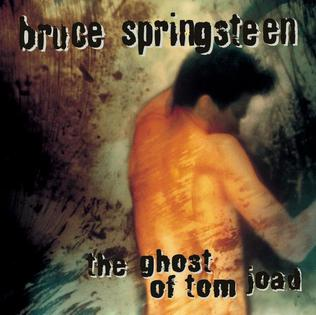
Bruce Springsteen- The Ghost of Tom Joad, 1995
Label: Columbia
Producers: Bruce Springsteen and Chuck Plotkin
By the middle of the 1990s, Bruce Springsteen found himself in a position now familiar to many of the superstars of the previous decade, and the Classic Rock-era as a whole, and one that stood in stark contrast to the commercial dominance he had achieved ten years prior. These artists suddenly found themselves cast aside from the mainstream, relegated to legacy status, and emphatically replaced by the fountain of new talents that brought virtually every genre down a divergent path in the new decade. While these acts no longer had a consistent home on top-forty radio, they still had plenty of vital art to offer, and were not satisfied settling for an existence merely touring off past glories culled from their Greatest Hits collections, his first of which Springsteen had released earlier in 1995. While he had enjoyed continued critical acclaim and renewed chart success the year prior with the title cut from the Streets of Philadelphia soundtrack, it was still clear that the Boss was at a creative crossroads. Like many of his peers, the time was ripe for a stylistic pivot and creative reinvention, and the newfound sectors such a move would expose him and his music to.
For Springsteen, that project proved to be The Ghost of Tom Joad, a stirringly stark contemporary folk album released in the fall of 1995. It was immediately apparent upon release that Joad owed its stylistic lineage to his 1982 landmark, Nebraska, the acoustic detour that he took before finally breakthrough to superstardom with Born In the U.S.A. Given that Nebraska was essentially a released demo record, there is certainly a higher production standard to be found on this album, but the performances and the subject matter found throughout are just as harrowingly dark. It returned Springsteen to the arena of sprawling, folk-spirited, mostly chorus-less, and grippingly vivid character sketches and stories. Conceptually, it reconnects him with framework of his pre-superstardom records. Yes, those themes and artistic points-of-view remained a creative through-line across all of his albums, but this was most certainly a return to their most bleakest and most cuttingly raw origins. In many ways, this record stands as the full realization of the vision first embarked on throughout Nebraska.
Joad also marked a return to more sociopolitical subject-matter for Springsteen, after shifting to more personal narratives beginning with Tunnel of Love. This was certainly not an unusual role for Bruce, having always been positioned as a voice for the blue-collar, common-man. However, to hear him return to these topics in the new era of the 1990s and the Clinton-era, especially in such gripping fashion, was a bit of a culture-shock for contemporary music during this time. It’s a period in American history commonly associated with economic prosperity, but Springsteen was acutely aware that not everyone was thriving, from immigrants and the homeless, to those displaced within the manufacturing and industrial sectors, to Main Street shop-owners depleted by shopping mall-culture (an issue he already addressed and forecasted on 1985’s “My Hometown”).
These are the characters that make up the dark and despondent stories of The Ghost of Tom Joad. The title track finds Springsteen drawing parallels between modern society’s abandonment of the most vulnerable class with the Depression-era tones of John Steinbeck’s The Grapes of Wrath and Woody Guthrie’s “The Ballad of Tom Joad”. “Straight Time” follows an ex-convict as he begins a new, clean life, as both he and his newfound wife try to ignore his inevitable slip back into addiction. “Highway 29” forms a dark and captivating Bonnie & Clyde tale, without all of the enticing thrills and outlaw-revelry, and only the most ominous and destructive elements of such a lifestyle. “Youngstown” tragically portrays a family on the brink of financial ruin caused by the collapse of the steel-industry, tracing their troubles through a crippling lineage of war-service, while laying blame at the feet of corporate America’s heartless ferocity (“Them big boys did what Hitler couldn’t do.”).
Some of the album’s most cutting tracks are those that explore the subject of immigration. These tales expose the hollow promises of hope and prosperity that sells the American dream to those who long to one day cross the border into a new, promising life. The Spanish-infused “Sinaloa Cowboys”, which follows two brothers who enter the United States despite their father’s prophetic warnings of disappointment, initially sounds like a sweeter and more uplifting moment on the album, before ultimately succumbing to the project’s tragic underbelly. “Across the Border” likewise offers an idyllic surface, depicting a young couple’s dreaming of a new future state-side. And while it’s one of the album’s only moments not to down-spiral into blatant despair, it’s hopefulness is clearly subverted by the harsh realities revealed for similar characters elsewhere on the album. There’s just a dash too much of bittersweet quality and naiveté to be found in the otherwise lovely harmonica and accordion solos that imbue the track.
In “Galveston Bay”, we witness an unnerving saga as a Vietnamese man who aided the American troops at war relocates to the US, only to be haunted by racism and threats of violence; a pretty stirring nod back to the true message of “Born In the U.S.A.”. And then there’s “The Line”, a sprawling piece that leaves the listener hanging onto every word of each revelatory verse. An INS border-patrol officer finds himself morally conflicted as he becomes enamored with a female border-crosser desperately seeking refuge for her family, before ultimately forgoing his professional duty and helping her pass to her destination. It’s a stunning story, very much in line with the social compass that has always run through Springsteen’s work. And how remarkable for it to be as potent as ever three decades on, given the tensions on the modern-day border, and the controversial tactics plaguing the issue of immigration in 2020s America. It’s timeless musical storytelling, rich in the pure folk tradition, and also the closest thing you’ll find to a happy-ending on all of Tom Joad. Meanwhile, the literal ending of the record, “My Best Was Never Good Enough”, is a surprisingly quaint and whimsical moment that finds Bruce breezily indicting all of life’s cliches of positivity. And there’s no more perfectly sardonic or ironically cheeky conclusion that one could think of for such a dark album. After all, the sad truth is that sometimes these platitudes are truly just words; futile in their attempt to change the reality of life’s cruelest of circumstances.
Ultimately, the brotherhood that exists between Nebraska and The Ghost of Tom Joad is more that just in its stylistic spirit. While both did in fact mark pivots creatively and stylistically, they both very much proved to be singular moments, and each transitional albums for Bruce Springsteen. Nebraska rewrote his artistic arc and his entire legacy overall, while providing a pause between his masterful but commercially fledging early period and the world-domination of Born In the USA. Tom Joad meanwhile provided him a creative revival after the lukewarm receptions to the 1992 twofer of Human Touch/Lucky Town, and while it would take seven years–his longest gap between studio albums ever–he would follow this project up with a triumphant reunion of The E-Street Band and a thrilling bounty of records comprising his true legacy-arc. Meanwhile, The Ghost of Tom Joad individually has garnered its own unique legacy in the past three decades. It’s certainly Springsteen’s most towering achievement in the 1990s, a beautifully devastating artistic achievement that likewise provided the decade with one of its most harrowing, and crucial social commentaries.
Track Listing:
- “The Ghost of Tom Joad” (Bruce Springsteen)
- “Straight Time” (Springsteen)
- “Highway 29” (Springsteen)
- “Youngstown” (Springsteen)
- “Sinaloa Cowboys” (Springsteen)
- “The Line” (Springsteen)
- “Balboa Park” (Springsteen)
- “Dry Lightning” (Springsteen)
- “The New Timer” (Springsteen)
- “Across the Border” (Springsteen)
- “Galveston Bay” (Springsteen)
- “My Best Was Never Good Enough” (Springsteen)
Previous: Lucky Town
Next: The Rising

