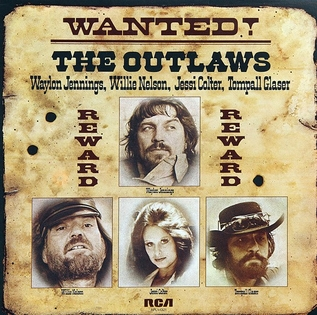
Waylon Jennings, Willie Nelson, Jessi Colter & Tompall Glaser- Wanted! The Outlaws, 1976
Label: RCA
Producers: Waylon Jennings, Willie Nelson, Tompall Glaser, Richie Albright, Chet Atkins, Danny Davis, Ray Kennedy, Ray Pennington, Shel Silverstein
It’s truly one of the most gratifying ironies in music history that Wanted! The Outlaws became the first country record to ever earn platinum-certification for one million albums sold. After all, the entire creative movement that it represented and helped solidify a legacy for was born in rebellion against the stifling, inauthentic recording environment that Nashville had become during the 1960s and early 1970s. Uniquely promising artists like Waylon Jennings and Willie Nelson had spent years seeing their stylistic and creative voices suffocated on their own records, while stuffy record executives and producers dictated what they sang, and how they sang it. This of course was all done in the interest of commercial hit-making, though neither Jennings or Nelson enjoyed much significant success with their own recordings under this system.
A pivotal turning point arrived in 1972 when both Nelson and Jennings hired manager Neil Reshen, a critical and often-unsung hero in the Outlaw movement story. With both Nelson and Jennings trapped beneath controlling deals with RCA Records, Reshen both assisted the former in exiting his contract with RCA altogether, and aided the latter in negotiating his deal with the label for complete creative control. This was the proverbial tip of the iceberg that would change the course of both careers, and country music’s legacy, forever. Under his new deal with Atlantic Records, Nelson retreated from Nashville back to Austin, Texas, and delivered a stirring string of classic LPs that fully realized his singular artistic potential. This tremendous arc began with 1973’s Shotgun Willie, continued through the following year’s Phases and Stages, and culminated with his Columbia Records debut, the seminal 1975 concept album, Red Headed Stranger. On the strength of the dark-horse hit cover of Fred Rose’s “Blue Eyes Crying in the Rain”, it became a commercial sensation, and forced the mainstream industry to finally sit up and take notice of the groundswell around them. Meanwhile, Waylon was ferociously crafting his own prolific run of classic LPs, which included Lonesome, On’ry and Mean, Honky Tonk Heroes, and Dreaming My Dreams. Also in 1975, Jennings’ wife, Jessi Colter solidified herself as the grand dame of the Outlaw movement when her single, “I’m Not Lisa” not only crowed the country singles chart, but became a top five pop smash as well. The Outlaws had officially completed their conquest for musical freedom and greatness, and in the process, conquered the entire country music industry that had previously suppressed them.
Which of course leads us to the actual album we’re showcasing today; not a collaboration between the four artists but rather simply a compilation of recent output from each of them. As documented above, this was not the record that spearheaded the Outlaw breakthrough, but was rather the record industry’s response to it. It should truly be treated as a mere appetizer when discovering this movement of music; your gateway to the essential recordings mentioned in the above paragraph. For those of us well indoctrinated into the thrills of the Outlaw movement, we know this record is a special souvenir; a superb initial taste that new listeners should view as a starting point. That’s not to downplay the music that is gathered here, which is indeed excellent. And it certainly cannot downplay the impact or importance of the album either. As much as it was RCA’s attempt to cash in on the commercial potential of the movement, it also tremendously exposed the greatness of these artists. It maximized the existing country audience’s appetite for the music while also extending its reach far beyond the genre. As musical gateway drugs, it may have been the most effective in popular music history to that point.
The marketing used to accomplish is also a magical and inextricable component to the album. From the fantastic album artwork (one of the greatest covers in history and one of my personal favorites) to Chet Flippo’s legendary liner notes, it further solidified the definitive Outlaw term and imagery surrounding the movement. It visually expressed the rock-tinged edge of the music to a young and hip segment of listeners that would have typically disregarded a country album as banal and insignificant. Of course, the fascinating (and not completely false, but certainly exaggerated) law-breaking connotations tied to Jennings and Nelson would become cliched and near-cartoonish like most popular music gimmicks in the years ahead, a point that Jennings legendarily bemoaned in his 1978 hit, “Don’t You Think This Outlaw Bit’s Done Got Out of Hand”. Overall though, it became a fitting and undeniably buzzy vibe associated with the era, and ultimately prevailed as a suitable metaphor for the liberating and rebellious spirit of the music itself.
Oh, and about the actual music? Well, the record actually starts off in surprisingly mellow fashion with Jennings solo reading of “My Heroes Have Always Been Cowboys”. It stylistically and thematically traces this fresh music’s roots back to the core traditions of classic Country & Western music and lore, thus exposing those magic qualities to a new audience whose curiosity had lured them to the project. Jennings’ fiery 1973 showcase on Billy Joe Shaver’s “Honky Tonk Heroes” proves to be the perfect follow-up to this opener, with its mid-song segue from acoustic honky-tonk to the thrilling, electric-guitar driven core Outlaw sound. This one song and musical transition alone perfectly depicted the sonic evolution of the genre and Jennings’ own musical journey, and sets the stage for the raw, uninhibited excitement of the album’s forthcoming selections.
Next, Colter’s gorgeously full-throated and bluesy voice gets the spotlight it so richly deserved on the haunting “I’m Looking For Blue Eyes”, previous single “You Mean to Say”, and when duetting with Jennings on a future hit cover version of “Suspicious Minds”. The duets continue as Side Two begins, this time between Willie and Waylon, which of course was the ultimate special sauce to the record, particularly on “Good Hearted Woman”, which became the ultimate anthem for the entire movement. In another slice of sweet justice, Nelson’s earlier RCA recordings of his own songwriting finally gets the mainstream attention it always warranted, with the inclusions of “Me and Paul” and “Yesterday’s Wine”. Both of these tracks were culled from 1971 recordings, but are gloriously remixed with the raw and rugged Outlaw sound replacing the syrupy Nashville gloss forced upon his early albums.
Finally, the record concludes with the appearance of Tompall Glaser, another underappreciated country journeyman who had been spinning his creative wheels in Music City for the better part of two decades. Jennings used his newfound pull at RCA to secure Glaser a spot on the record, and ole Tompall proves to be the dark-horse showman of the album. He brings the house down with his burly, jovial readings of both a Jimmie Rodgers standard (“T for Texas”) and beloved Outlaw scribe Shel Silverstein (“Put Another Log on the Fire”), once again demonstrating these artists’ ability to reinvigorate country music’s present and future, while restoring its past. The other remaining (anti) heroes of Wanted! are naturally ace musicians like Mickey Raphael, Ray Kennedy, Gary Tallent, Robby Turner, Richard Bennett, and Greg Morrow, who provide these tracks with the primal, tantalizing musicianship called for by the artists and the songs.
Both the immediate and long-lasting impact of Wanted’s success cannot be overstated. Most obviously, it secured both Jennings and Nelson’s status as leading country superstars and stylistic innovators well into the 1980s. It also gave Colter and Glaser a permanent legacy in the genre’s story, something that criminally may have been denied them otherwise. Within the genre space, it restored an elevated layer of gritty excitement and edge to the country charts, heightening a counterpoint to Nashville’s increasingly cross-over minded scene that predecessors like Johnny Cash, Merle Haggard, Loretta Lynn, Bobby Bare, Sammi Smith, and Kris Kristofferson had provided during the first half of the seventies. The movement also continued to provide a sterling showcase for other singer-songwriters similar to Kristofferson such as the aforementioned Shaver, Silverstein as well as legends like David Allan Coe, Johnny Paycheck, Mickey Newbury, Guy Clark, Townes Van Zandt, and Jerry Jeff Walker. And in the decades and generations ahead, names like Hank Williams Jr., Moe Bandy, Joe Ely, Tanya Tucker, John Anderson, Steve Earle, Travis Tritt, Gretchen Wilson, Miranda Lambert, Jamey Johnson, Eric Church, Chris Stapleton, Sturgill Simpson, Shooter Jennings, Orville Peck, Charley Crockett, Margo Price and others have dutifully kept the spirit of Outlaw Country alive and thriving. But none of them even see those opportunities without the trailblazing represented by this album, and certainly none of them will ever quite capture the unparalleled, thrilling spark that Willie, Waylon and the boys (and girls) produced during this fascinating time in music history.
Track Listing:
- “My Heroes Have Always Been Cowboys”- Waylon Jennings (Sharon Vaughn)
- “Honky Tonk Heroes”_ Waylon Jennings (Billy Joe Shaver)
- “I’m Looking For Blue Eyes”- Jessi Colter (Jessi Colter)
- “You Mean to Say”- Jessi Colter (Colter)
- “Suspicious Minds- Waylon Jennings & Jessi Colter (Mark James) *Single Release 1976
- “Good Hearted Woman”- Waylon Jennings & Willie Nelson (Waylon Jennings, Willie Nelson) *Single Release 1976
- “Heaven or Hell”- Willie Nelson (Nelson)
- “Me and Paul”- Willie Nelson (Nelson)
- “Yesterday’s Wine”- Willie Nelson (Nelson)
- “T for Texas”- Tompall Glaser (Jimmie Rodgers)
- “Put Another Log on the Fire (Male Chauvinist National Anthem”- Tompall Glaser (Shel Silverstein)

