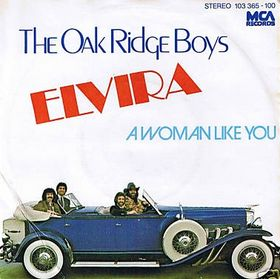
Oak Ridge Boys- “Elvira”
Label: MCA
Songwriter: Dallas Frazier
Producer: Ron Chancey
This past week sadly played host to another loss in the musical universe, with the death of Richard Sterban, whose unmistakable bass vocals were a central ingredient to the Oak Ridge Boys‘ ascendance to the heights of country music royalty and crossover success in the late 70s and early 80s. And while there were many essential performances that exemplified this fact, none will ever be as memorably definitive as “Elvira”, easily one of the quirkiest novelties to ever enter both the country and pop stratospheres, not to mention one of the most beloved and iconic.
By the time the Oaks applied their vocal quartet magic to the track on their 1981 album, Fancy Free, the enigmatic Elvira had already charted quite the intriguing path throughout the country music underground. Written by the prolific Dallas Frazier (“Timber, I’m Falling”, “There Goes My Everything”, “All I Have to Offer You (Is Me)”, “What’s Your Mama’s Name”, “Beneath Still Waters”, “If My Heart Had Windows”, “Fourteen Carat Mind”), he was the first to record it to minor success in 1965. Its next notable iteration would arrive in 1970, at the hands of future country legend, Kenny Rogers, and his psychedelic country-rock outfit, The First Edition. Next, Rodney Crowell featured the song on his 1978 cult-classic debut album, Ain’t Living Long Like This, featuring harmonies from Emmylou Harris. This proved to be the first truly transformative rendition of the song, with the randy undertones of the lyrics’ affection for Elvira really coming to the forefront, via the bawdy vocal interplay between Crowell’s lead and the nearly orgasmic tremble in Harris’ backing vocals.
Fast-forward three years, and the Oak Ridge Boys had settled into their most famous line-up (Duane Allen- lead vocals, William Lee Golden– baritone, Joe Bonsall- tenor, and Sterban- bass), and had already established themselves as one of the leading acts amongst the evolving country music scene during the Urban Cowboy movement. After three decades performing primarily gospel music, the band’s indelible harmonic blend–now combining the hair-raising glory of the church and the hell-raising thrills of the honky tonk–had struck country gold. Prior to the creation of this specific ensemble’s seventh studio set, Fancy Free, the group had already amassed three No. 1 country singles, including another cut from the forementioned Crowell album, “Leaving Louisiana in the Broad Daylight” (which was also covered fabulously by Miss Emmylou). But, the true potential of their success was about to be revealed, thanks to the alluring temptress at the center of Frazier’s nearly two-decade old tune.
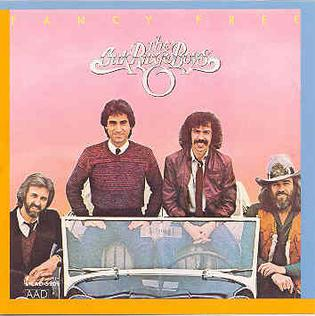
In the hands of the Oaks, “Elvira” found her true identity as a campy charmer. Like so many of the Boys’ imperial hits, this record struck a perfect balance between cheeky charisma and pure vocal prowess. The true charm of the Oak Ridge Boys’ music was that the group rarely took their material all too seriously; their priority was always placed on simply entertaining their audience, and providing them with effortless escapism. Nevertheless, they always avoided being cast as a pure comedy act, thanks to the pure vocal chops that were always at the heart of the magic musical connection between its four members. If any record of theirs is the ultimate definition of this special sauce, it’s “Elvira” hands down. Joe Bonsall’s signature jovial nature puts a completely new and infectious spin on the lyrics, making the narrator’s professions pure, flirtatious adoration. Sterban meanwhile always plays the perfect foil to Bonsall, with his deep, hollerin’ bass stealing the show on the song’s timelessly silly hook: “Giddy up, um-poppa-um-poppa, mow mow/Giddy up, um-poppa-um-poppa, mow.” It was down-home enough to maintain the song’s pure country identity, but infectious enough to be irresistible to a wider audience.
And the rest, as they say, is history. As the lead single to Fancy Free, “Elvira” easily soared to No. 1 on the country charts, but also crested the top five of the Billboard Hot 100, becoming one of country music’s most lucrative crossover songs, not only during the genre-blurring 80s, but of all time. Its source album not only became the band’s first to crown the country albums chart, but surpassed double-platinum status, which was still a prestigious rarity for a country album. As the 80s unfolded, the Oaks logged an additional twenty entries in the country top ten, including thirteen more No. 1s. Among those was the 1982 follow-up, “Bobbie Sue”, which incorporated the same vocal cosplay of “Elvira”, with Sterban’s booming bass once again providing the signature hook.
Besides a few hiatuses, the core line-up of the Oak Ridge Boys settled comfortably into their status as a legacy act in the 1990s and beyond, remaining a steady touring favorite, and releasing new albums as recently as 2011. They were elected to the Country Music Hall of Fame in 2015. Bonsall sadly succumbed to ALS in 2024, when his replacement, Ben James stepped in for him on one final group album later that year, the Dave Cobb-produced Mama’s Boys. Sterban succeeded him in death last week, after a battle with pancreatic cancer.
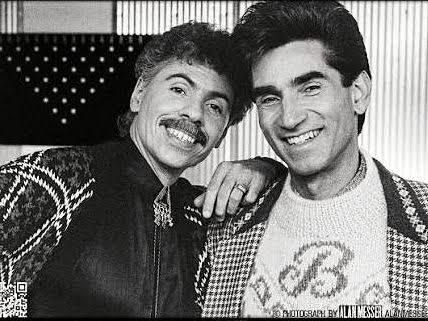
This half of the core Oak Ridge Boys may no longer walk among the living, but their unique chemistry with one-another specifically, but also with Allen and Golden, will live on forever across the countless musical memories they created together. And “Elvira” will forever be chief among them; a timelessly entertaining and enduring moment across the entire popular music spectrum.
And, just in case it’s not already lodged in your brain for the rest of the year, here’s one more “Giddy up, um-poppa-um-poppa, mow mow”…


Leave a Reply