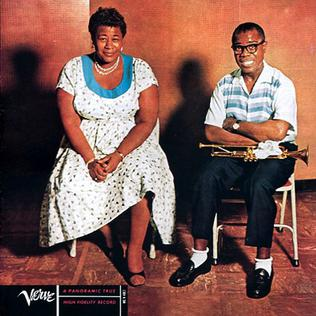
Ella Fitzgerald & Louis Armstrong- Ella and Louis, 1956
Label: Verve
Producer: Norman Granz
The inaugural collaborative album between jazz pioneers Ella Fitzgerald and Louis Armstrong is, of course, a masterclass in every way imaginable. The vocal purity and prowess. The delicately tasteful jazz instrumentation throughout, courtesy of the Oscar Peterson Quartet, and of course, Armstrong’s virtuosic trumpeting. The elegant song selection from the likes of American songbook scribes like Irving Berlin, Ian & George Gershwin, Hoagy Carmichael, and others; all of these tunes were already standards and further propelled to such status as a result of these performances. But, what Ella and Louis truly accomplished more than anything is in how it helped redefined the magical possibilities of the American vocal duet. Up to this point, across the various genres of popular music, the majority of vocal collaborations had comprised of tight-knit familial harmonies, or male-female pairings that could be considered stylistic twins of one-another. Fitzgerald and Armstrong however, no matter how similarly acclaimed their pure talents and contributions to jazz greatness may have been, were drastic opposites in terms of vocal character. And that’s precisely where the album’s most sublime powers lie: in the captivating contrast between Ella’s pure, crystalline range and Louis’ soulful, sandpaper grit.
The two greats had originally hinted at their wondrous collaborative chemistry on two duet tracks for Decca Records a decade earlier in the winter of 1946. Verve Records founder, and this album’s producer, Norman Granz had clearly noted this, and upon the opening of his label and the subsequent acquisition of Fitzgerald’s enormous talent for the roster, one of his first tasks was to broker this project between she and Armstrong. Granz clearly understood both the box-office potential, and spell-binding musical possibilities of such a union, and Ella and Louis generously delivered in both regards. Granz obviously knew that the pairing of the two legends would already provide the key ingredient for greatness, but it was also clearly understood that such a lofty union would require the very best songs, musicians, and production choices to support them. With a ballad-heavy setlist on their hands, the Oscar Peterson Quartet (with Peterson on piano, Herb Ellis on guitar, Ray Brown on bass, and Buddy Rich on drums) astutely provide the cozily romantic and softly seductive brand of straight-forward musical beauty that the affair calls for. And of course, their gorgeous but subtle presence allows them to naturally forfeit the instrumental spotlight to Armstrong as needed for each of his signature, show-stopping trumpet solos, of which prove to be just as enticing a duet partner for Fitzgerald’s emotive pipes as Armstrong’s voice itself.
Naturally of course, it is the two singers’ vocal union that remains the main attraction of this beautiful gem of an album. Each of these duets build that anticipation to that emotional payoff with suave and intelligent patience. It’s compelling enough to hear their voices trading off between verses, but when their respective signing finally touches for the first time on opener “Can’t We Be Friends”, we’re hearing musical history in the making. This fabulous reward repeats itself for the next ten selections, and the results are timelessly enchanting. Fitzgerald’s graceful emotive powers combined with Armstrong’s richly tender phrasing on lines like “Let the rain pitter-patter” on Berlin’s “Isn’t This A Lovely Day” is just one of the many singular moments that help define the album’s greatness. With the Gershwin classic, “They Can’t Take That Away From Me”, we’re treated to one of popular music’s spotlighting of the sheer transformative and nostalgic power of music, and how it can keep life’s memories alive. It’s also one of the album’s more subtly playful moments. Armstrong’s signature reedy tremble and rumbling vocal growl is simply mesmerizing against Fitzgerald’s silky smooth stylings, as well as the joyful swing that the Quartet provides. Meanwhile, Side One concludes in joyously thrilling fashion on “Tenderly”, where Ella finally brings out her signature scat, only this time as a booming impression of Louis himself. The admiration that these two artists clearly feel for one another is joyfully palpable here, and you can also sense the undeniable wonder they, like the rest of us, feel when their voices meet.
Above all, it’s the evocative power of this record, similar to their own solo classics and the greatest moments in all of vocal jazz, that is ultimately its most stirring and lasting quality. On gorgeous chestnuts like the vibrant “Moonlight in Vermont”, the starry-eyed “Under a Blanket of Blue”, or the dreamy “Stars Fell in Alabama”, the listener is absorbed into the vivid settings and stories of these songs by the pure power of these voices and the music. Whether you’re a part of a new generation discovering this album for the first time, or have spent your entire life listening to it, this special quality is equally powerful. This ability arguably reaches its most notable heights in another Gershwin gem, “A Foggy Day”. There’s something so visually compelling about Louis’ voice narrating a gloomy day in London, only for Ella’s bright, expressive vocals to arrive right on cue and symbolize the sunshine’s parting of the clouds. What a definitive marriage of singers and song. The same can of course be said for Berlin’s “Cheek to Cheek”, for which this version remains one of its most ultimate renderings, no matter how endlessly its been recorded for nearly a century. This performance sways, swells, and surrenders in such splendid fashion, from Armstrong’s gregarious growl, to Fitzgerald’s magnetic majesty, to their collectively hushed finale.
The album concludes with the tender intimacy of Vernon Duke and Yip Harburg’s “April in Paris”, a warmly resonant closer that displays the tender ranges of both singers, as well as their combined tone, in exceedingly soothing fashion. It’s a bittersweet recording, but especially so given its status as the moment that cues the ending of Ella & Louis. As a listener, you find yourself both overjoyed by how wonderful this album is, while also mourning the fact that it’s over. Thankfully, it would not be the final time the two would unite, with more collaborations to follow on 1957’s Ella and Louis Again, and 1959’s Porgy and Bess. There are plenty of stellar moments to find on those releases, but Ella Fitzgerald and Louis Armstrong’s first album together remains their most essential. There’s nothing flashy that documents jazz music’s expansive power through dexterous experimentation and improvisation. Instead, it’s a pristine example of the simple purity and romantic magic at the central roots of vocal jazz and traditional pop. And those special elements, just like these two magnificent singers, are timeless wonders to behold.
Track Listing:
- “Can’t We Be Friends?” (Paul James, Kay Swift)
- “Isn’t This A Lovely Day?” (Irving Berlin)
- “Moonlight in Vermont” (John Blackburn, Karl Suessdorf)
- “They Can’t Take That Away from Me” (Ira Gershwin, George Gershwin)
- ‘Under a Blanket of Blue” (Jerry Livingston, Al J. Neiburg, Marty Symes)
- “Tenderly” (Walter Gross, Jack Lawrence)
- “A Foggy Day” (Gershwin, Gershwin)
- “Stars Fell on Alabama” (Mitchell Parish, Frank Perkins)
- “Cheek to Cheek” (Berlin)
- “The Nearness of You” (Hoagy Carmichael, Ned Washington)
- “April in Paris” (Vernon Duke, Yip Harburg)

