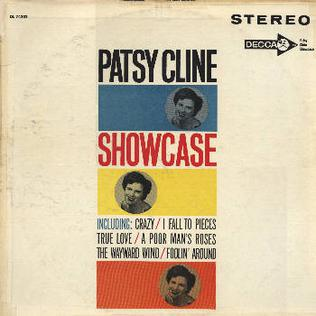
Patsy Cline- Showcase, 1961
Label: Decca
Producer: Owen Bradley
It’s nearly impossible to imagine now, but at one point in time during the early fifties, Patsy Cline herself was just another aspiring artist, seeking an elusive breakthrough to stardom. And blasphemous as it sounds, her spectacular, once-in-a-lifetime voice did not result in the type of overnight success that her immense talent would warrant. Instead, Cline spent a large span of the decade cutting her teeth on the country circuit in her home-state of Virginia, and recording Country & Western sides for upstart label 4-Star Records. The singles they released on Cline failed to gain traction, a disappointing trend that continued for Patsy even after she relocated to Nashville, and became affiliated with both the Grand Ole Opry and Decca Records. With the exception of “Walkin’ After Midnight”, which became one of the first bona-fide country crossovers on the pop charts, none of the material from her 1957 self-titled debut brought Cline any significant attention.
This trajectory would take a dramatic and positive turn in 1961, as Cline prepared to release her long-overdue sophomore LP, Showcase. By this point, the stylistic trends in Nashville and mainstream country music had deviated from the twangy edge of fifties honky-tonk and rockabilly toward a glossier pop sound, in an attempt to compete with the arrival of rock & roll, which had threatened to erode the genre’s audience. Incorporating lush orchestral arrangements and “countrypolitan” imagery, the Nashville Sound as it would become known, was pioneered by artists like Eddy Arnold and Jim Reeves, and legendary producers like Chet Atkins and Owen Bradley. Bradley had already been at the producer’s helm of Cline’s twangy debut, but he astutely recognized that this new style was a perfect match for Cline’s gorgeous powerhouse voice.
Showcase would be the glorious moment where this premonition came to beautiful fruition. Vocal group The Jordanaires, who had also previously supported Elvis Presley on his recordings, were recruited to play a key role in capturing the new stylistic vision Cline and Bradley were aiming for. The group’s rich, booming voices proved to fabulously compliment Cline’s soaring feminine croon, and together their vocals became one of the definitive pillars of the early sixties’ era in popular music. Another critical component to the success of Patsy’s new sound was Bradley’s prioritizing Cline’s enormous range at the forefront of his production choices. The pop-country stylings on Showcase were not nearly as dramatic as those employed on records by Arnold or Reeves. Instead, there’s a jazz-styled intimacy that not only fits Cline’s voice like a glove, but also helps make Patsy’s music so uniquely wondrous. It’s more “cocktail-country” than the full-blown “countrypolitan” of most Nashville Sound productions; you can also reference Ray Price’s pristine Night Life to better understand the difference. It’s these types of subtle but important choices by Bradley that perfectly suited the thrilling arcs of her legendary voice; at times tender and others triumphant. Somber one moment, and devastating the next.
Her voice could sound magnificent singing anything. The new stylistic path helped secure a soundscape to best display it. And finally, the elevation of material to the top-shelf songs chosen here was the ultimate clincher in delivering the masterpiece that Patsy Cline was destined to create. Her and Bradley’s gracefully curation of Harlan Howard and Hank Cochran’s “I Fall to Pieces” opens the album in revelatory fashion, and officially established Cline’s signature sound, an affirmation solidified by its ascendance to the top of the country songs chart, and the pop top ten. As the record progresses, we’re spoiled with Cline’s equally elegant interpretations of diverse touchstones across the fields of country (Buck Owens’ “Foolin’ Around”, Floyd Tillman’s “I Love You So Much It Hurts”), Western swing (Bob Wills’ “San Antonio Rose”), classic pop (Gogi Grant’s “The Wayward Wind”, the standard “South of the Border”, and Cole Porter’s “True Love”). She also proves that she can still be just as twangy and saucy as her earlier records on “Seven Lonely Days”, and on updated recordings of previous hit, “Walkin’ After Midnight” and its B-side, “A Poor Man’s Roses (Or a Rich Man’s Gold), where her honky-tonk roots remain prominent, but with a charming refresh thanks to the addition of the Jordanaires.
And then, there’s “Crazy”, the sensational recreation of Willie Nelson’s perennial classic that would help establish him as a musical poet, and become Cline’s magnum opus in terms of technical power, stylish phrasing, and emotional resonance. It also became her third bona-fide smash on the pop singles chart, forever confirming her catalog as a groundbreaking precursor to the crossover country hits that would follow throughout the decades. It’s easily a final ballot-contender for the greatest single recorded performance of all-time, and the undeniable anchor to Showcase.
Of course, we sadly know what would soon follow for Patsy Cline. Sixteen months after the release of this classic album, and with only one additional studio album to follow in the interim, she was tragically killed at the age of thirty, in the prime of her life and on the brink of soaring superstardom. The devastating loss silenced one of the greatest pure vocalists of all time, leaving music-lovers to forever fantasize about where her musical path would have taken her in the decades ahead. As a result, Showcase is forever positioned as a true musical time-capsule. And oh, what a marvelous capsule it is. As a listener, you’re instantly transported any time it plays and left both weeping and in awe of her towering talent as a pure vocalist and seamless singing stylist. Patsy Cline’s greatness will never, ever be duplicated, and this is indeed her ultimate Showcase.
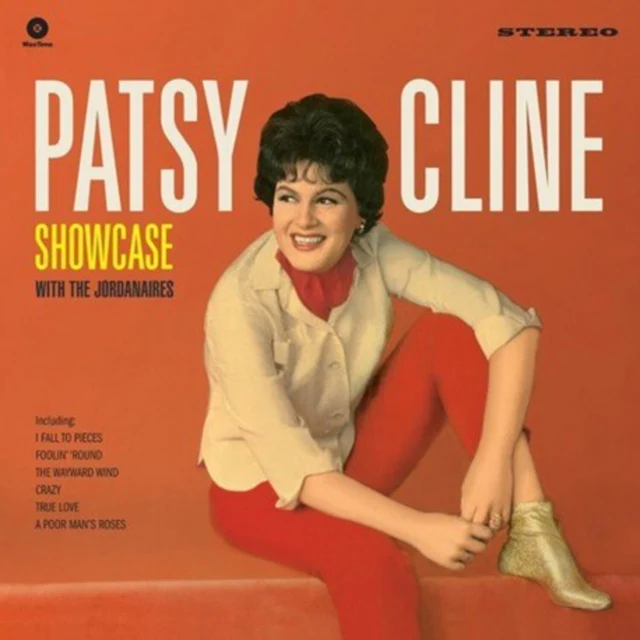
Track Listing:
- “I Fall to Pieces” (Hank Cochran, Harlan Howard)
- “Foolin’ Round” (Howard, Buck Owens)
- “The Wayward Wind” (Stanley Lebowsky, Herb Newman)
- “South of the Border (Down Mexico Way)” (Michael Carr, Jimmy Kennedy)
- “I Love You So Much It Hurts” (Floyd Tillman)
- “Seven Lonely Days” (Marshall Brown, Earl Shuman, Alden Shuman)
- “Crazy” (Willie Nelson)
- “San Antonio Rose” (Bob Wills)
- “True Love” (Cole Porter)
- “Walkin’ After Midnight” (re-recording) (Alan Block, Don Hecht)
- “A Poor Man’s Roses (or a Rich Man’s Gold)” (re-recording) (Bobb Hilliard, Milton DeLugg)
- “Have You Ever Been Lonely (Have You Ever Been Blue)” (George Brown, Peter DeRose)

