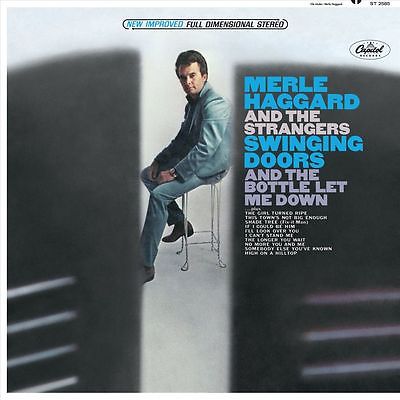
Merle Haggard, Swinging Doors & The Bottle Let Me Down, 1966
Label: Capitol
Producers: Ken Nelson and Fuzzy Owen
While the Hag’s 1965 debut album was a solid introduction to a promising new figure in the growing Bakersfield Sound movement, Strangers was more of an impressive vocal showcase than anything else, with the singer simply navigating and adapting to a slew of influential sounds. Conversely, his sophomore follow-up released one year later found the future legend combining those musical roots more thoroughly with his own authoritative identity, both vocally and as a songwriter. It’s a thrilling experience listening to him find his voice in both ways, while beginning a song canon that would ultimately go down as one of the most important in all of music. Not only does this record show Haggard himself coming into his own individually, but his band The Strangers also start to take on their own personality as a unit, in turn also helping to lay the groundwork for the musical muscle that would support Haggard’s pure country narratives for years to come.
Wrapped up in the title of the album are his first two true classic compositions, with both emphatically announcing Merle Haggard as one of the great poets for the boozing and broken-hearted, and likewise forming a one-two punch of proportions that has arguably never been matched on another country record. “Swinging Doors” is the first of those honky-tonk gems, opening the set with a tremendous steel solo from Ralph Mooney in what is unquestionably one of the most iconic musical moments in the country lexicon. With this classic track, Haggard sets the tone out of the gate, not only for the album, but really for his entire career. It’s a stark portrait of a man whose broken heart has relegated him to a new home in the barroom. The entire cut is a blueprint for country gold. The cutting, pointed lyrics soaked in Haggard’s deliciously tattered delivery are further punctuated by stellar steel and Telecaster solos, perfectly subtle strokes of honky-tonk piano, and the floating, haunting harmonies of Haggard’s then-wife and fellow country star, Bonnie Owens. All these great elements coalesce to illustrate the true permanency of this man’s exile. This is his home now and he’s serving a long sentence in the name of heartache. Listeners understandably loved Haggard for character sketches such as these, as they connected with their own loneliness and life struggles, and served both as a topical and musical alternative to the lush Nashville Sound of the preceding era.
As the album progresses, it unveils a solid set of expertly sung and played stories that brought long-time country fans back to the themes of the honky-tonk glory days of the 40’s and 50’s. All but two of them were written or co-written by Haggard, providing further evidence of the blossoming scribe within him. “If I Could Be Him” depicts a man lusting for the touch of his friend’s wife. Singing his own material, Haggard’s voice sounds considerably more confident and lived in when compared to the performances on his debut. Frank and wrought with guilt, yet still willing to sacrifice anything for one night of infidelity, Haggard’s gritty and honest pipes prove to be the perfect vehicle to bring this character to life. The fact that Haggard had in fact married fellow star and friend Buck Owens’ wife may have helped.
That steadfast realism and honesty thrives throughout the entire album, whether we’re hearing him plead for his soon-to-be ex to get her leaving over with in “The Longer You Wait”, or completely denying the end is near in “I’ll Look Over You”. Bouncier up-tempos like “I Can’t Stand Me” or “Shade Tree Fix It Man” let his signature country growl take center stage, while both the saucy novelty of “The Girl Turned Ripe” and the gospel tinges of the Tommy Collins-penned “High On A Hill Top” offer glimpses into other personality traits that would be explored more thoroughly throughout his storied career.
As mentioned above, keeping up with Haggard every step of the way is his crack ensemble The Strangers, a healthy rotation of notable musicians that were quickly on their way to becoming one of country music’s most revered side groups. Among those appearing here included Mooney with his unmistakable cry on pedal steel, Glen D. Hardin on piano, Jerry Ward on bass, the aforementioned Owens with her sensationally subtle but ghostly harmonies, and sizzling guitar picking from the likes of James Burton, Roy Nichols, and rising West Coast superstar Glen Campbell. In an era where supporting ensembles still had significant identities of their own, there’s no denying the importance these musicians would play in affirming Haggard’s musical palette across his incomparable 60’s run of classic albums, which all gets started here.
It’s at the beginning of side-two that Haggard unveils the other signature anchor of this album with “The Bottle Let Me Down”, a future standard and his first true masterpiece. The country canon is defined by its legion of classic drinking songs, but perhaps no other has ever so effectively presented alcohol as a symbol of such heartbreak. This is the portrait of a man whose devastation is so profound that not even the liquor can erase his sadness. The lonesome wail of Haggard’s voice combined with the chilling supporting harmonies throughout perfectly portray how dejected and numb the narrator is now that his one last escape has finally failed him. If any one piece on this album represents the moment that Merle Haggard emerged as the voice for the heartbroken and down-trodden, this is certainly it. Sixty years of classics may have followed it, but this may still be his defining moment on record.
Track Listing:
- “Swinging Doors” (Merle Haggard) *Single Release 1966
- “If I Could Be Him” (Haggard)
- “The Longer You Wait” (Haggard)
- “I’ll Look Over You” (Haggard)
- “I Can’t Stand Me” (Haggard)
- “The Girl Turned Ripe” (Haggard)
- “The Bottle Let Me Down” (Haggard) *Single Release 1966
- “No More You and Me” (Haggard)
- “Somebody Else You’ve Known” (Haggard)
- “High on a Hilltop” (Tommy Collins)
- “This Town’s Not Big Enough” (Liz Anderson, Donna Austin)
- “Shade Tree (Fix-It Man)” (Haggard) *Single Release 1965

